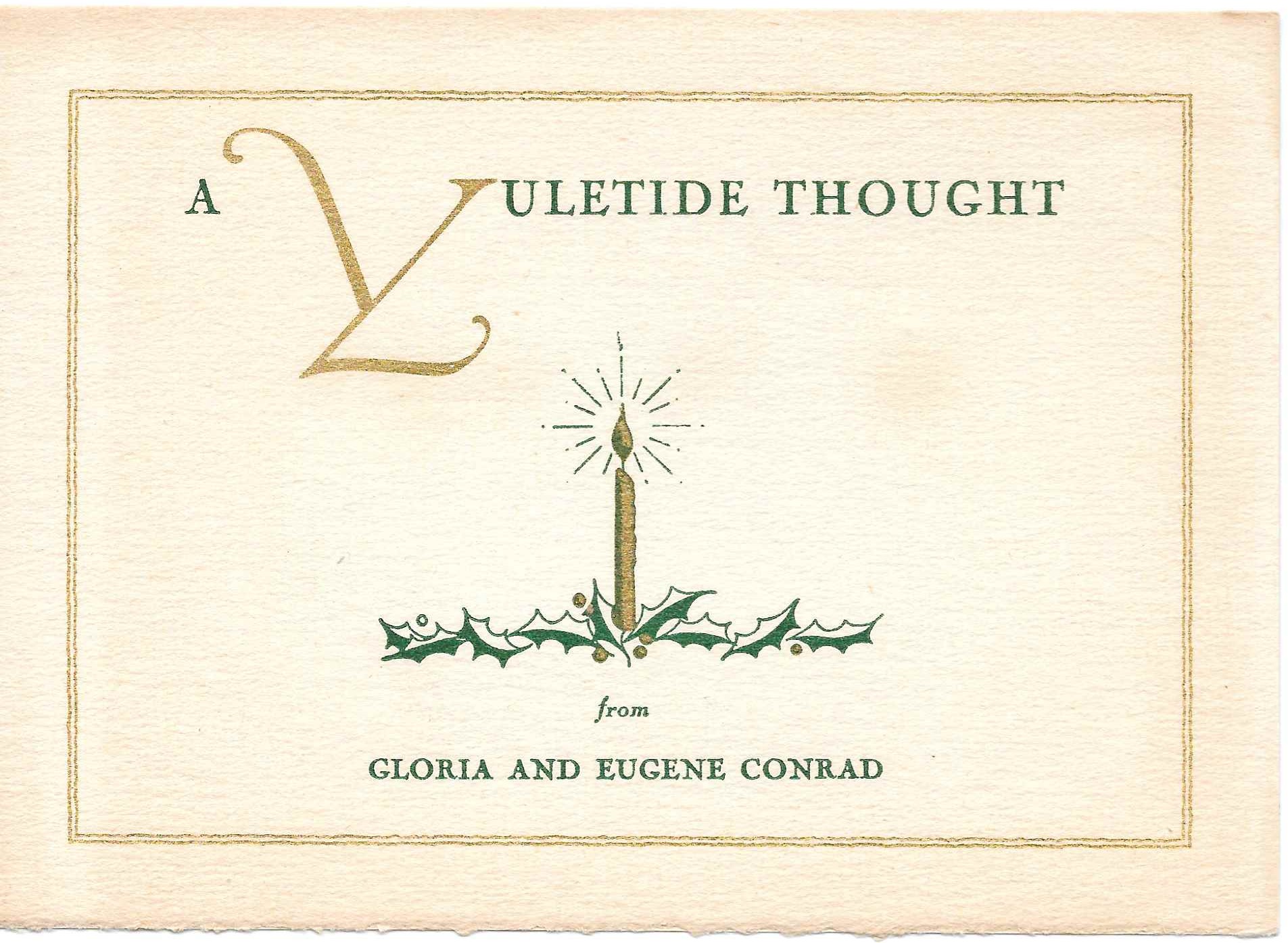
I do not know who Gloria and Eugene Conrad were. I assume he was a US military officer in WWII. The couple sent this card in 1945. It contains an odd yuletide message.
Sending Christmas greetings using paper money was apparently unique to service members in China during WWII. It may have been because the notes were colorful and inexpensive. Inflation had made the lower denomination Chinese paper money practically worthless. I have seen many examples from China but not a single one from any other part of the world.
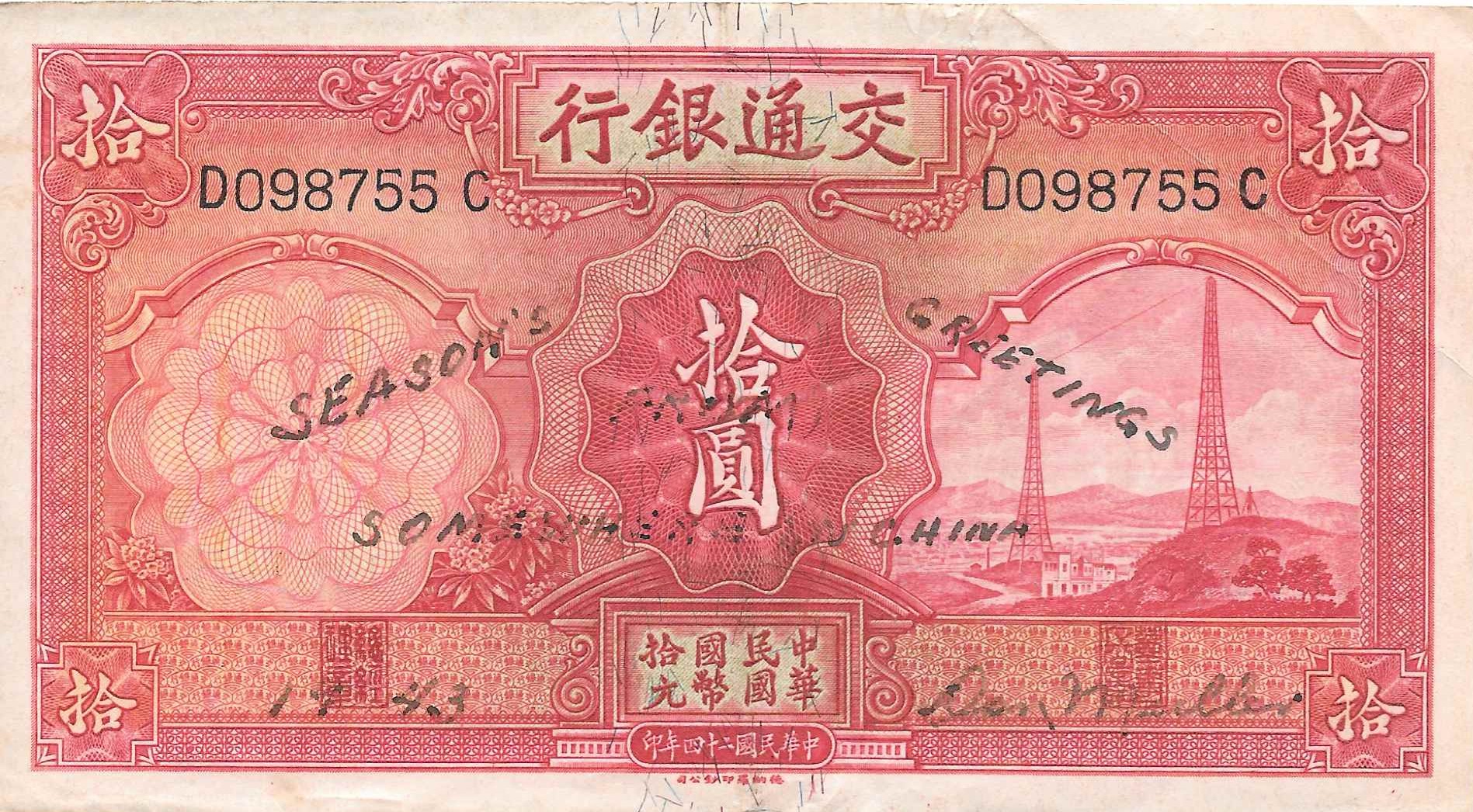
US Army Major Don Muller wrote his Christmas greeting on this 10 yuan note from the Bank of Communications.
An otherwise anonymous Marine named Bud used this note from the Central Bank of China for his holiday message in 1946.
The stamp on this Central Bank of China 10 yuan note appears on many different types of notes. Three of the five notes I have with this stamp are signed by different people. I have not been able to connect them together so it is unknown whether the stamp was duplicated or used in only one location.
Back to the Conrads. They chose to affix a note issued by the Japanese for use in the Dutch East Indies to spread good tidings and cheer in a backhanded way. Even as a numismatist their card would have made me wince had I received it in 1945.
The last installment showcased the first note in the collection. This one will show the most recent.
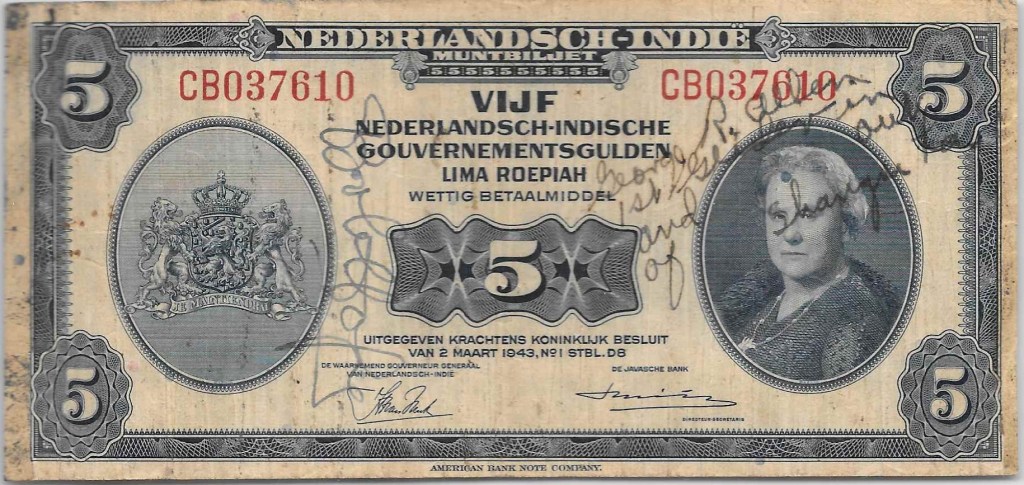
This note is a well-used 5 roepiah note from the Netherlands East Indies. This series of notes was printed by the American Bank Note Company toward the end of WWII at the direction of the government-in-exile. They were introduced into the islands upon liberation from the Japanese.
There are three handwritten inscriptions on the note. In numismatics this is known as a short snorter. Short snorters were souvenirs made from paper money when autographed by a group who traveled together. The practice started with bush pilots in the 1920s and spread slowly among fliers and passengers. If you were a short snorter and met another who traveled in your group you produced your note. If the other person could not produce their note, you were owed a drink.
They became popular during WWII. As service members traveled from country to country they would tape notes from each country together. Some of these rolls are dozens of notes long. The tape on the edges of this note show that it was once part of a roll of notes.
[TANGENTIAL RANT: There is an ebay seller who buys short snorter rolls, cuts the notes apart and sells the individual notes. This is a sacrilege as it destroys an historical artifact by removing some of its context.]
Signatures were collected from comrades, entertainers, senior military personnel, political leaders and others who were encountered. Internet resources have made it possible to identify many of the signers of these notes. Ancestry.com, fold3.com, newspapers.com and unit specific sites that contain rosters and other documents are invaluable.
Back to the note. The signature on the back is Gilbert Cant who covered the war in the Pacific for Time Magazine. The signature on the left of the face is Bob Hope. (Rotate your device 90 degrees to the left and you will see it).
If these were not fascinating enough, the inscription on the right of the face of the note is more interesting. It reads: George R. Allen, 1st glider in and out of Shangri La. The inscription is a memento of a miraculous rescue mission that occurred in the mountainous jungle of Dutch New Guinea in 1945.
Shangri-La was the name given to a secluded and scenic valley in Dutch New Guinea. On May 13, 1945, a C-47A took off from Hollandia on a sightseeing tour with a crew of five and nineteen passengers. The plane crashed in the interior mountains of the island. Nineteen of the twenty-four on board died in the initial crash. Two more died soon thereafter. The three survivors were Sgt. Kenneth Decker, Cpl. Margaret Hastings and Lt. John McCollom. McCollom’s brother was one of the victims.
Decker, McCollom and Hastings (U.S. Army Photo)
The survivors were spotted a few days later. The remote location made their rescue problematic. The mountains and the jungle did not allow for an airplane to land and take off safely, and helicopters could not operate in the high altitude. Reaching them on the ground would have taken months.
The air force hatched the improbable plan of clearing a landing strip and inserting gliders. Paratroopers were deployed to the valley to give medical support and clear the landing strip. Food and other supplies were airdropped. By mid-June 1945, the landing strip was cleared but bad weather delayed the rescue.
The operation called for gliders to land and then be picked up one-by-one as the tow plane passed by overhead. Three gliders would be needed to remove all the survivors and support personnel. On June 26, 1945, the weather cleared and the first CG-4 glider towed by a C-46 landed in the valley. The pilot of the first glider was Capt. George R. Allen. Allen’s landing was without incident but the retrieval had a few complications. Despite this, Allen’s CG-4 was picked up and the journey out of the jungle began. The other two landings and retrievals were without incident.
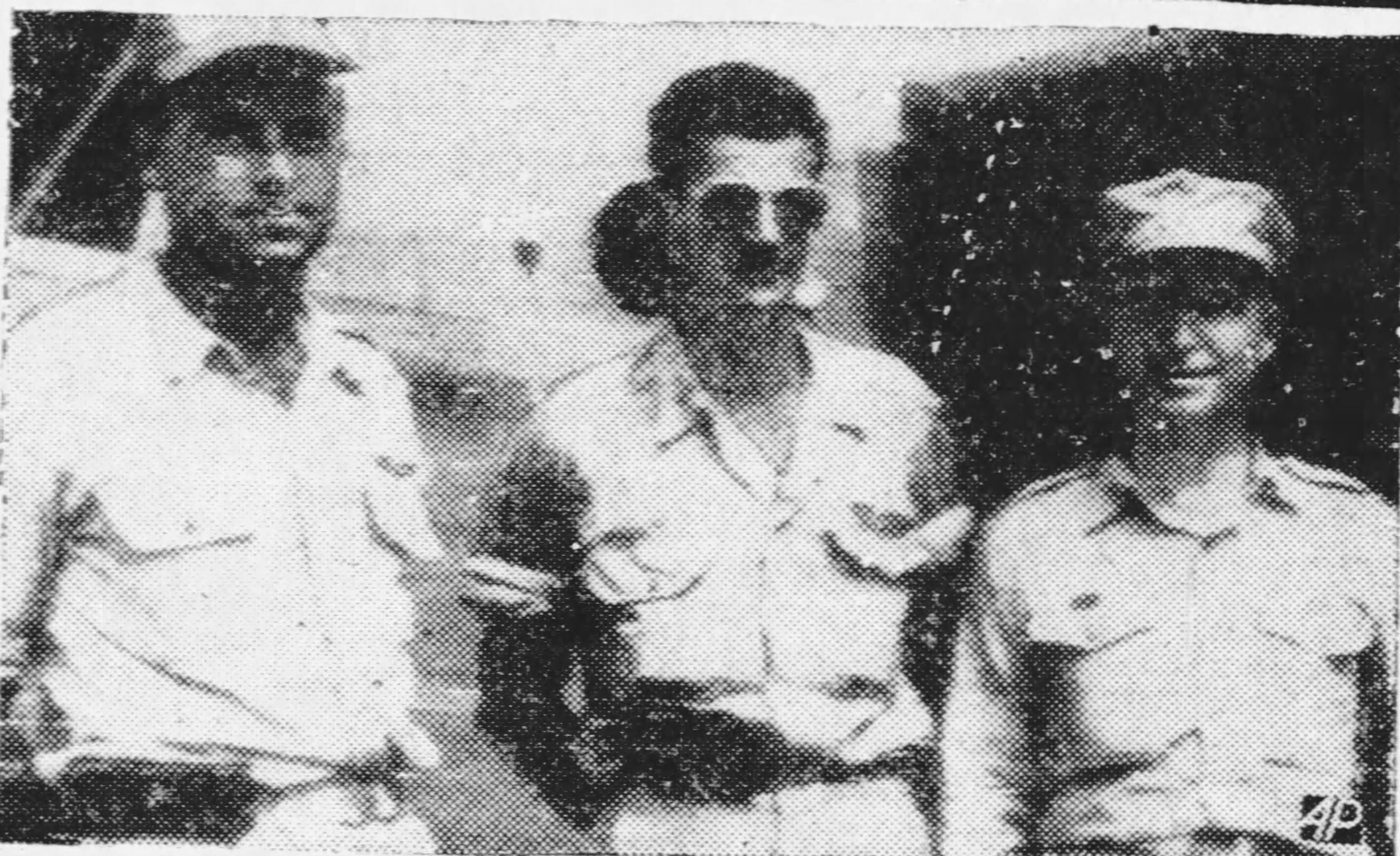
Capt. George R. Allen, Lt. Henry E. Palmer and Col. Ray T. Elsmore, the three glider pilots who effected the rescue from Shangri-La. (AP Photo)
The rescue operation received considerable press at the time. A reporter had been dropped in and recorded the rescue on film. The video can be found on youtube. It was the subject of a book written in 2011 by Mitchell Zuckoff titled Lost in Shangri-La: A True Story of Survival, Adventure and the Most Incredible Rescue Mission of World War II.
On November 11, 2018, I posted on Facebook a medal issued by the City of New London, Wisconsin inscribed to Theodore Schaller who was the only resident of that community to die in WWI. A few people who saw that post suggested I make other numismatic related posts. Rather than post them on Facebook I have started this blog.
This is the first time I have used WordPress. I am learning the site as I go so do not expect much in these early posts. I hope you enjoy reading these posts as much as I do writing them.
In the Beginning . . .
For my first entry I thought it appropriate to highlight the item that started it all. Note number 1, so to speak.
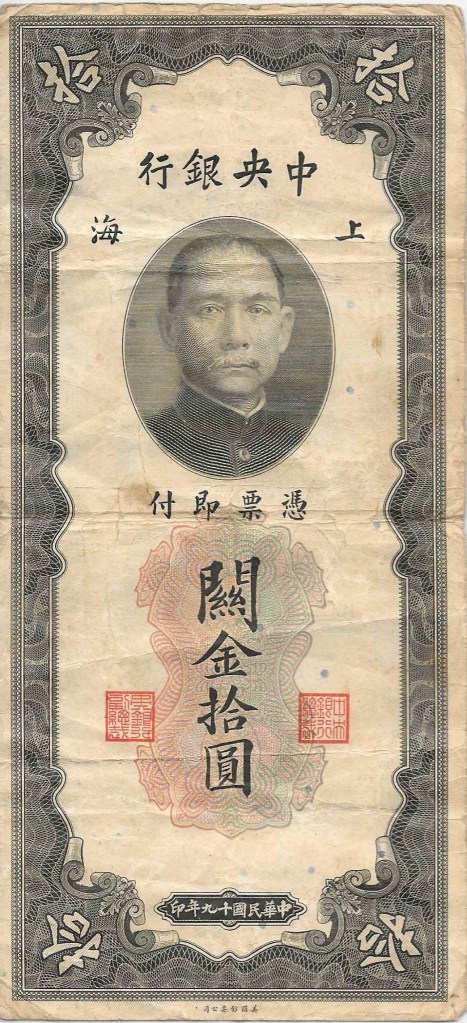
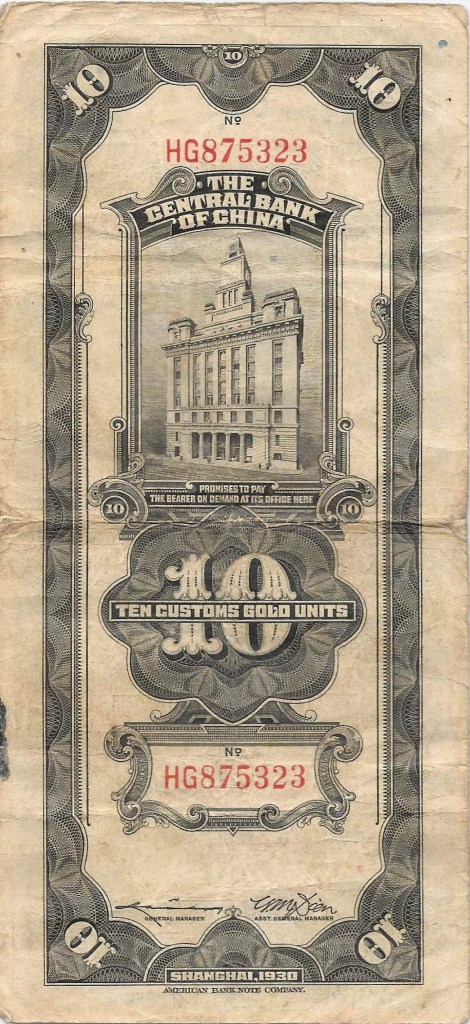
The note is a Central Bank of China 10 customs gold unit (CGU) note. These notes were originally issued in 1930 to pay customs duties. The notes insulated importers from changes in the dollar/yuan or pound sterling/yuan exchange rates. The initial value was 1 CGU = US$.40.
CGU notes had limited circulation prior to WWII. The original purpose for the notes was eliminated in 1941 when customs duties were changed. CGU notes began to circulate as regular currency in Nationalist controlled China at a rate of 1 CGU = 20 CNC (Chinese National Currency or yuan). Increased government expenditures for the war against Japan and then the Chinese Civil War led to rampant inflation and a dramatic increase in denominations of both CNC and CGU notes.
The pre-war CGU notes were issued in denominations of 10 and 20 cents, and 1, 5, and 10 CGU. During WWII, 20 and 50 CGU notes were introduced. After the war, values up to 250,000 CGU were printed.
All the CGU notes were of similar design. A portrait of Dr. Sun Yat Sen appears on the face and the customs house in Shanghai is on the back. Several printers were used for the notes. All except two varieties are vertical format. It was the vertical format thethat first drew me to the note.
I acquired the 10 CGU note pictured above on December 7, 1975. I know the date because it was my first communion. I bought it and a partially filled Lincoln penny book from one of my brothers using the $5.00 my grandmother gave me that day. He got the better end of the deal.
My interest in coins and paper money waxed and waned over my teenage years based largely on the availability of material. Flea markets were the only source in the late 1970s and then it was very limited. I had no access to reference books and felt my way through hobby darkness until 1987. But I will save that story for another day.





 Numismatic Notebook