Short snorters are souvenirs made from banknotes. They usually bear the signatures of travelling companions. They originated with air travelers but became popular during WWII with service members overseas. Since the notes used were not going to be spent, short snorters were usually made on low value currency.
This $50.00 US Federal Reserve Bank Note represents the highest denomination short snorter I have encountered. FRBN were originally printed and issued in 1933 during the Bank Holiday to increase the money supply on the banking system. They stopped being issued when the emergency passed. The unissued stock of notes remained in the vaults of the US Treasury.
The notes were called into service again during WWII. Full employment, increased wages and wartime demands on the Bureau of Engraving and Printing combined to put a strain on the money supply. FRBN were once again injected into commerce to alleviate the shortage.
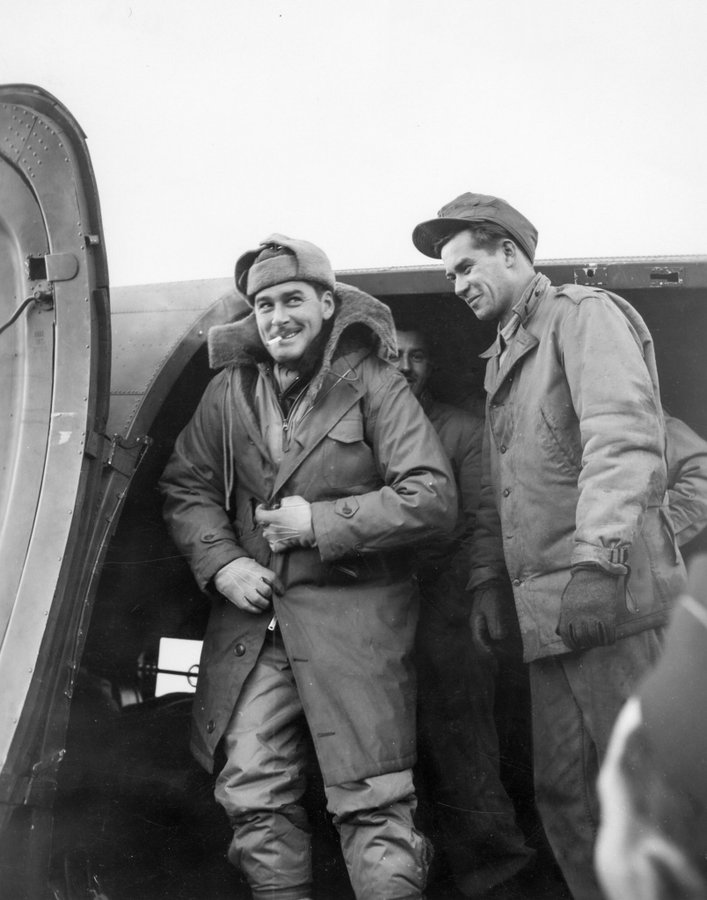
Errol Flynn arriving in Alaska in 1943. (US Navy Photograph).
The signatures on the note indicate why it was saved. The signatures are two different USO shows who visited Dutch Harbor and the Aleutians in 1943. The most significant signature is Errol Flynn (upside down on the lower right of the face). The others from his tour are Harry Mendoza, Martha O’Driscoll, Ruth Carrell and Jimmie Dodd. The other group is Gerald Griffen, Eleanor Padova, Gerry Knox and Conchita and Lari.
Excerpt from the War Diary of the Naval Operating Base at Dutch Harbor, Alaska for December 1943 identifying the USO troupes who visited that month.
One of the unfortunate characteristics of short snorters is that there is often no indication of who saved the note. This is the case here where there is no way to tell from the note itself who had the wherewithal to use a $50.00 bill as a souvenir.
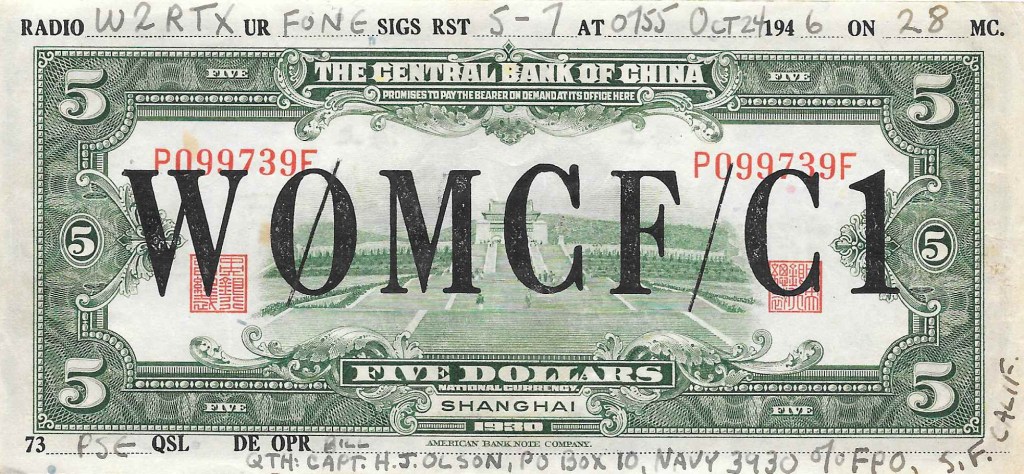
A Central Bank of China $5.00 note used as a QSL card by Capt. H.J. Olson. Olson was with the US Navy in Shanghai in 1946.
Amateur radio enthusiasts take pride in their ability to send to and receive transmissions from distant locations. Since radio transmissions are transitory, they needed a way to document that these long distance communications occurred. The QSL card was developed in the 1920s to do this.
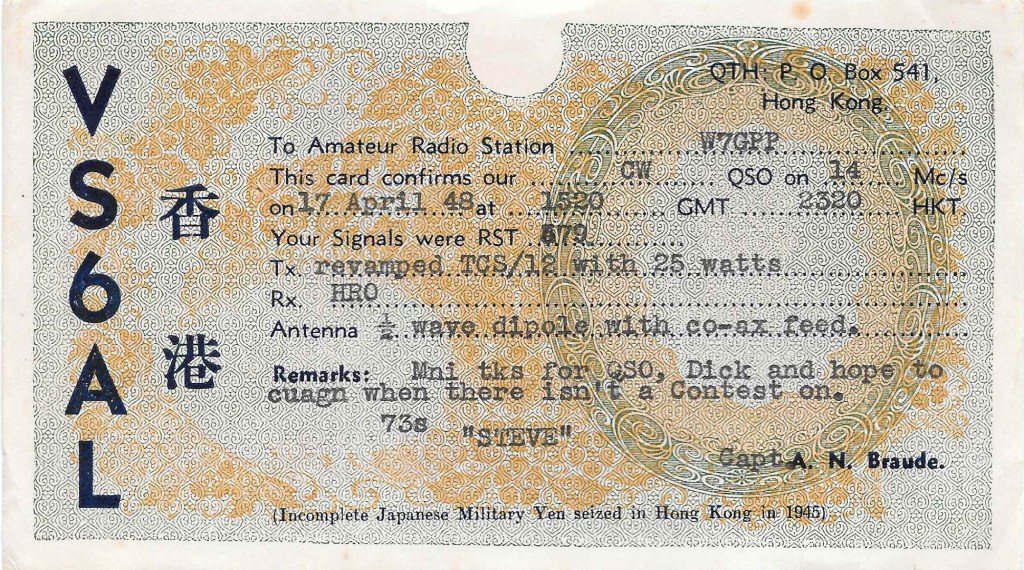
Captain A. N. Braude of the Hong Kong Volunteer Defence Corps used this unfinished Japanese printed note for Hong Kong as a QSL card in 1948. Braude was taken prisoner in 1941 and liberated in 1945.
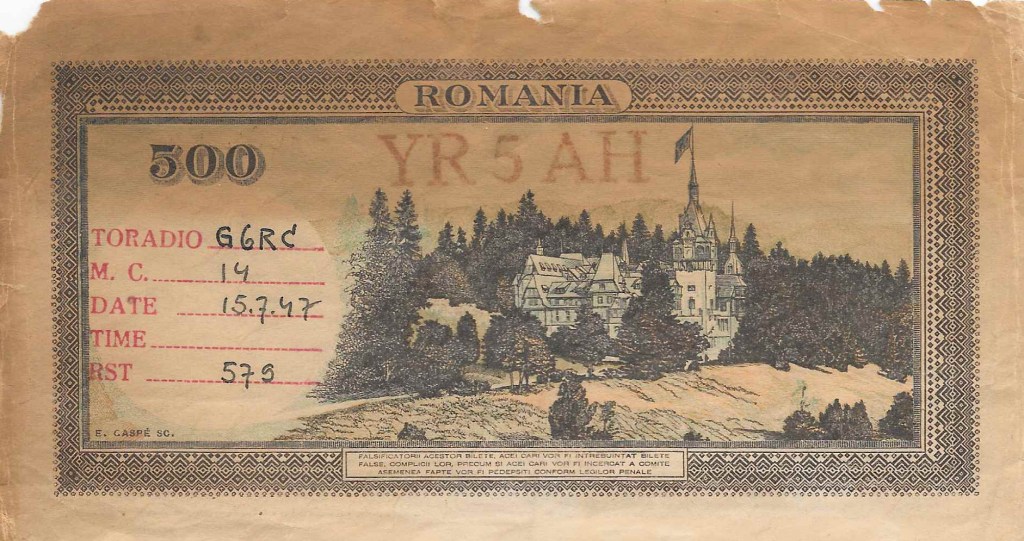
A QSL card is usually a post card that includes at least the following information: (1) the call sign of both stations, (2) the time and date (usually using UTC), (3) the radio band used, (4) the mode of transmission and (5) a signal report.
Romanian 500 lei note used as a QSL card by Anton Hapsburg, Archduke of Austria, while living in Romania in 1947. Hapsburg was an ardent amateur radio enthusiast who insisted on being referred to by the shorthand Kai-Ho an abbreviation for the German Kaiserlicher Hoheit (Imperial Highness).
The name “QSL card” comes from the Q code “QSL”. Q codes are a type of shorthand used in radio transmissions. QSL means “I acknowledge receipt of your transmission.” As a question, QSL? means “Can you acknowledge receipt of my transmission?”
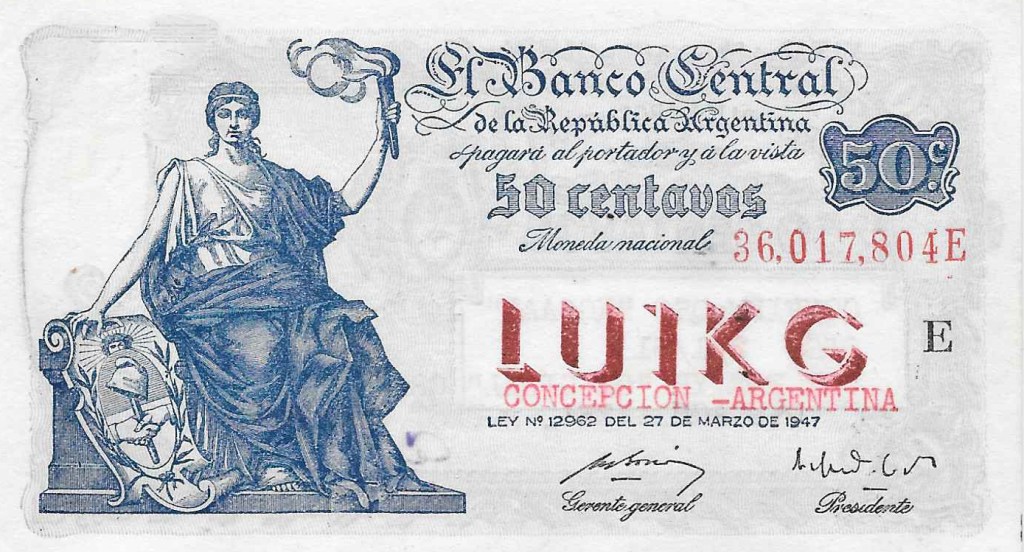
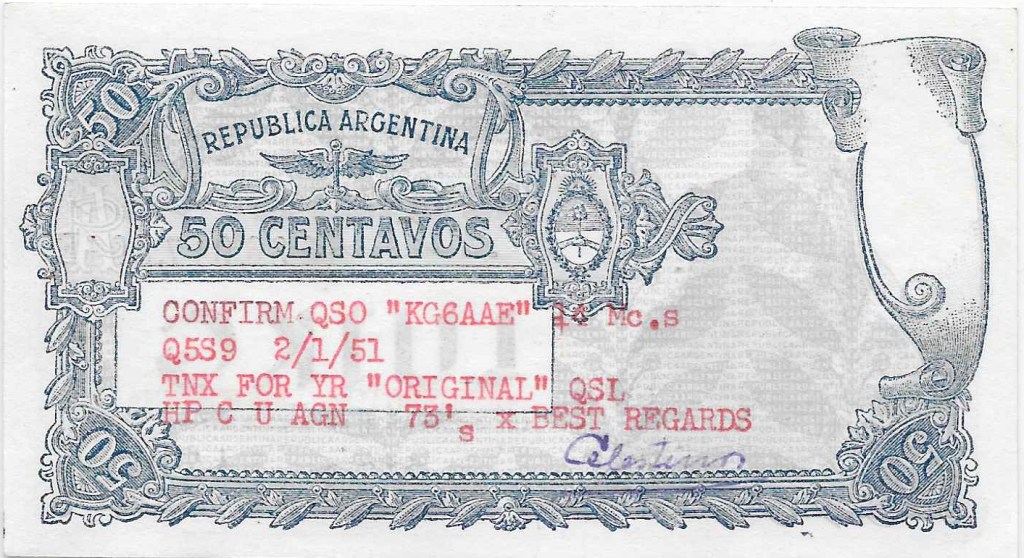
Face and back of an Argentine 50 centavos note used by an amateur radio operator in that country in the 1950s
QSL cards are frequently customized to highlight information about the sender or where the sender lives. Industry publications included the names and call signs of hobbyists looking for connections and willing to confirm communication with a QSL card.
Thousands of different QSL cards have been produced. A few of these have been made on paper money and are interesting crossover collectibles for these two hobbies.
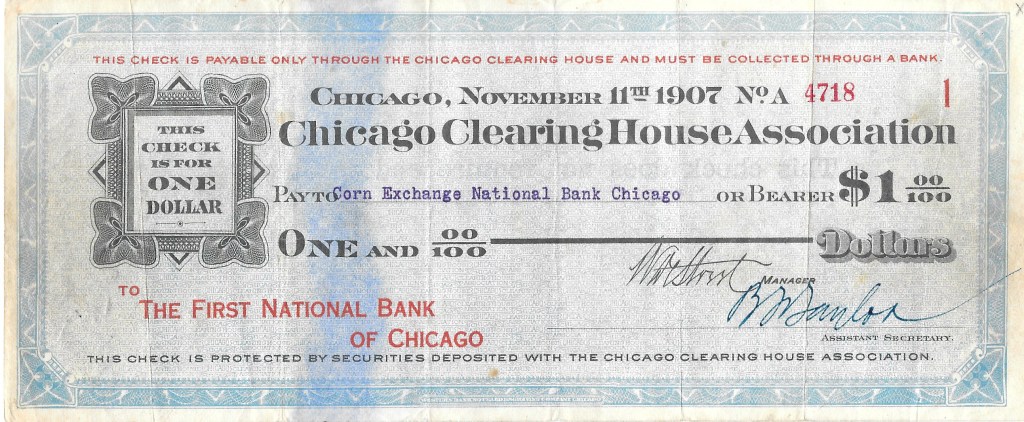
Chicago Clearing House check issued during the Panic of 1907. This is one of the more common types of scrip available..
The Panic of 1907 was a crisis in the US financial markets that occurred at the end of 1907 and carried into the beginning of 1908. The crisis caused the value of the New York Stock Exchange to drop nearly 50%.
In October 1907, an attempt was made to corner the market in the United Copper Company. The attempt was unsuccessful and the financial institutions that financed the takeover attempt could not recover leading to the collapse of the Knickerbocker Trust Company of New York. The dominoes began to tumble and panicked depositors pulled their money from the banking system.
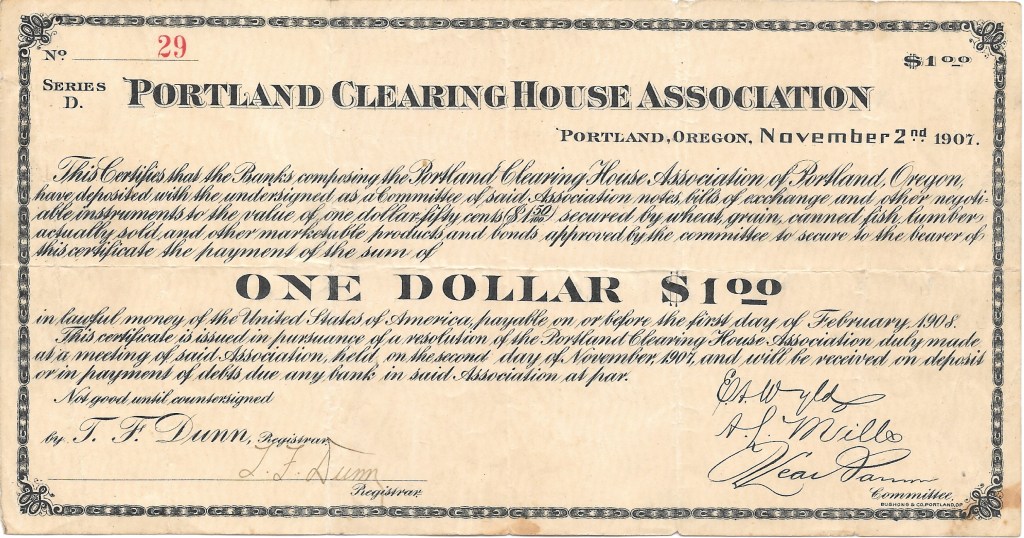
Portland Clearing House Certificate from November 1907.
The country was already in a recession when the banking crisis struck a significant blow to a shaky economy. The panic began to ease as J.P. Morgan and other New York financiers pledged their assets to prop up the banks. But then another emergency arose.
The brokerage house of Moore and Schley was heavily in debt using its holdings of the Tennessee Coal, Iron and Railroad Company as collateral. When the companies stock price fell, the brokerage firm was in trouble. At the same time, the Trust Company of America and the Lincoln Trust Company were also teetering on the brink.
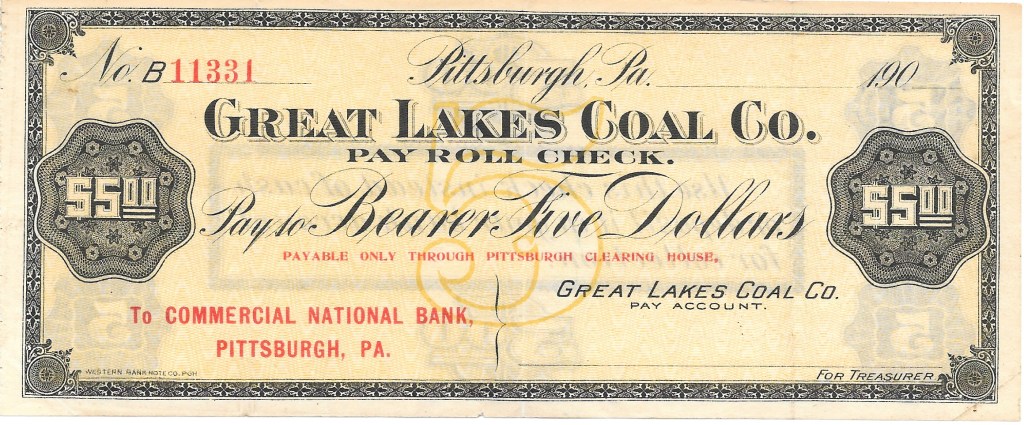
Payroll check issued by the Great Lakes Coal Company of Pittsburgh during the Panic of 1907.
J.P. Morgan again stepped in with a plan for his US Steel to purchase the Tennessee Coal, Iron and Railroad Company. As a condition to making this happen, Morgan demanded that the solvent banking institutions rescue their failing cousins. The bankers eventually agreed but President Roosevelt’s anti-monopoly sentiment presented a potential road block. US Steel had 60% of the US market and an additional acquisition would result in intense scrutiny from the president.
These latest events occurred over the weekend of November 2, 1907. Resolution was necessary before the markets and banks opened on November 4. On Sunday afternoon, Morgan sent his representatives to Washington. The president’s secretary refused to allow them to meet with Roosevelt. It took the intervention of Secretary of the Interior James Garfield to get the ear of the president. Roosevelt understood the gravity of the situation and approved the plan as the sun arose on November 4. Crisis was averted again.
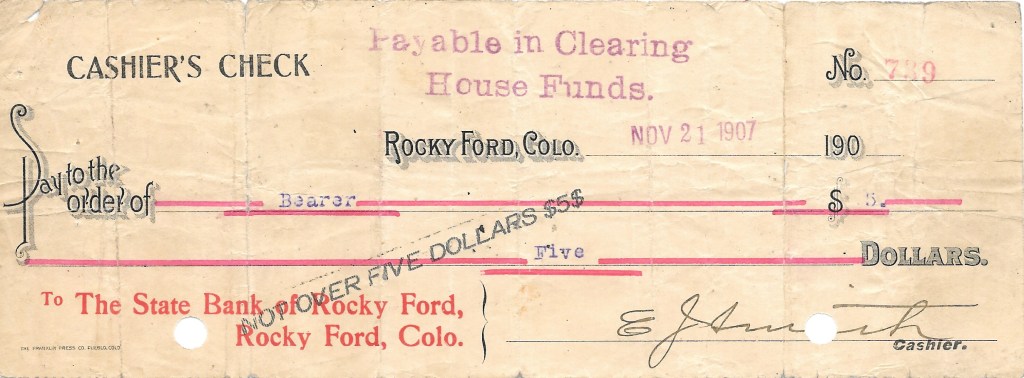
Circulating bearer cashier’s check from Rocky Ford, Colorado.
In order to meet the cash shortages that spread throughout the country, local scrip was issued to provide a medium of exchange. The scrip was mostly in the form of circulating cashier’s checks and clearing house certificates. Hundreds of different varieties of these certificates representing millions of dollars were issued locally but no national solution was available.
The Panic of 1907 demonstrated that the Department of the Treasury’s control over the money supply was inadequate to meet the illiquidity in the financial system caused by the bank failures and depositors’ withdrawals. The lessons learned resulted in the creation of the Federal Reserve System in 1913.
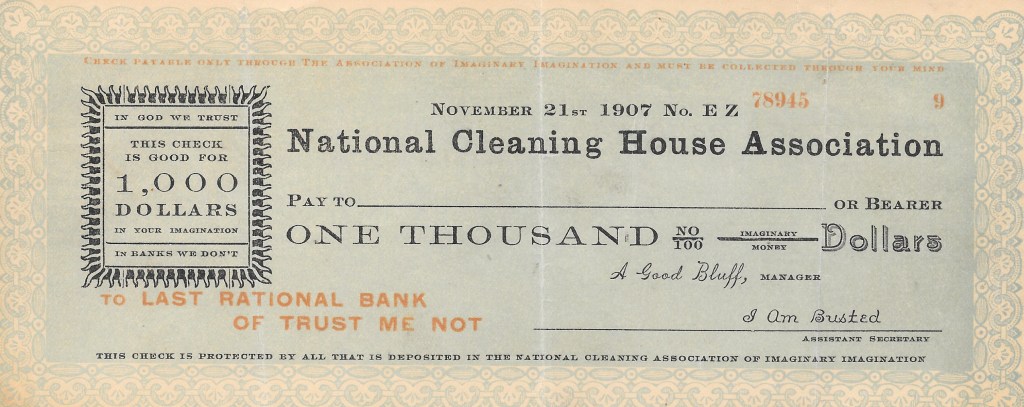
Satirical $1,000 Cleaning House Association Certificate.
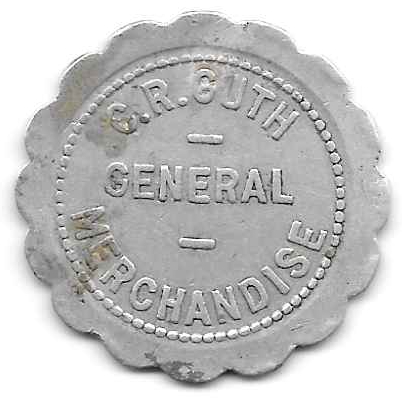
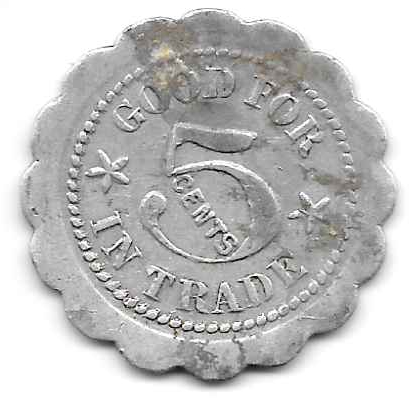
Obverse and reverse of a 5 cent token from Conrad Guth’s general store in Kolberg, Wisconsin
Conrad R. Guth was born on November 24, 1873 in Forestville, Door County, Wisconsin. His parents, Charles Guth and Albertina Kay, were immigrants from Germany. His father built the first frame house in the Forestville area.
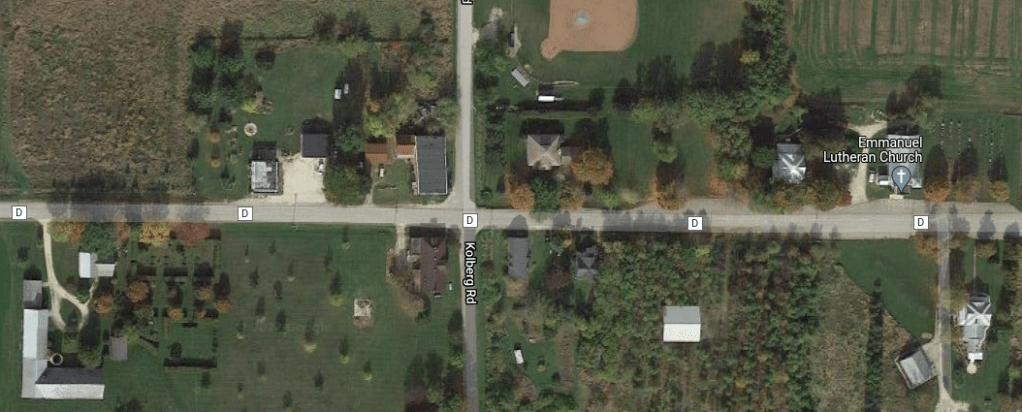
Guth worked on a farm in Sawyer, Wisconsin (now part of Sturgeon Bay) and then in Menominee, Michigan. In 1893, he built a cheese factory on land his father had purchased in Kolberg, Wisconsin. Kolberg is a small, unincorporated community in the Town of Brussels, Door County, Wisconsin.
C. R. Guth’s General Store in Kolberg, Wisconsin (right) in 1907.
He opened a general store in Kolberg which was described as having the largest stock of any general store in the county. In 1903, the store was expanded. He also continued to operate the cheese factory and a creamery.
He remained in business in Kolberg until 1918 when he sold his enterprises and moved to Oneida County. There he purchased the Lakeview Inn on Pelican Lake.
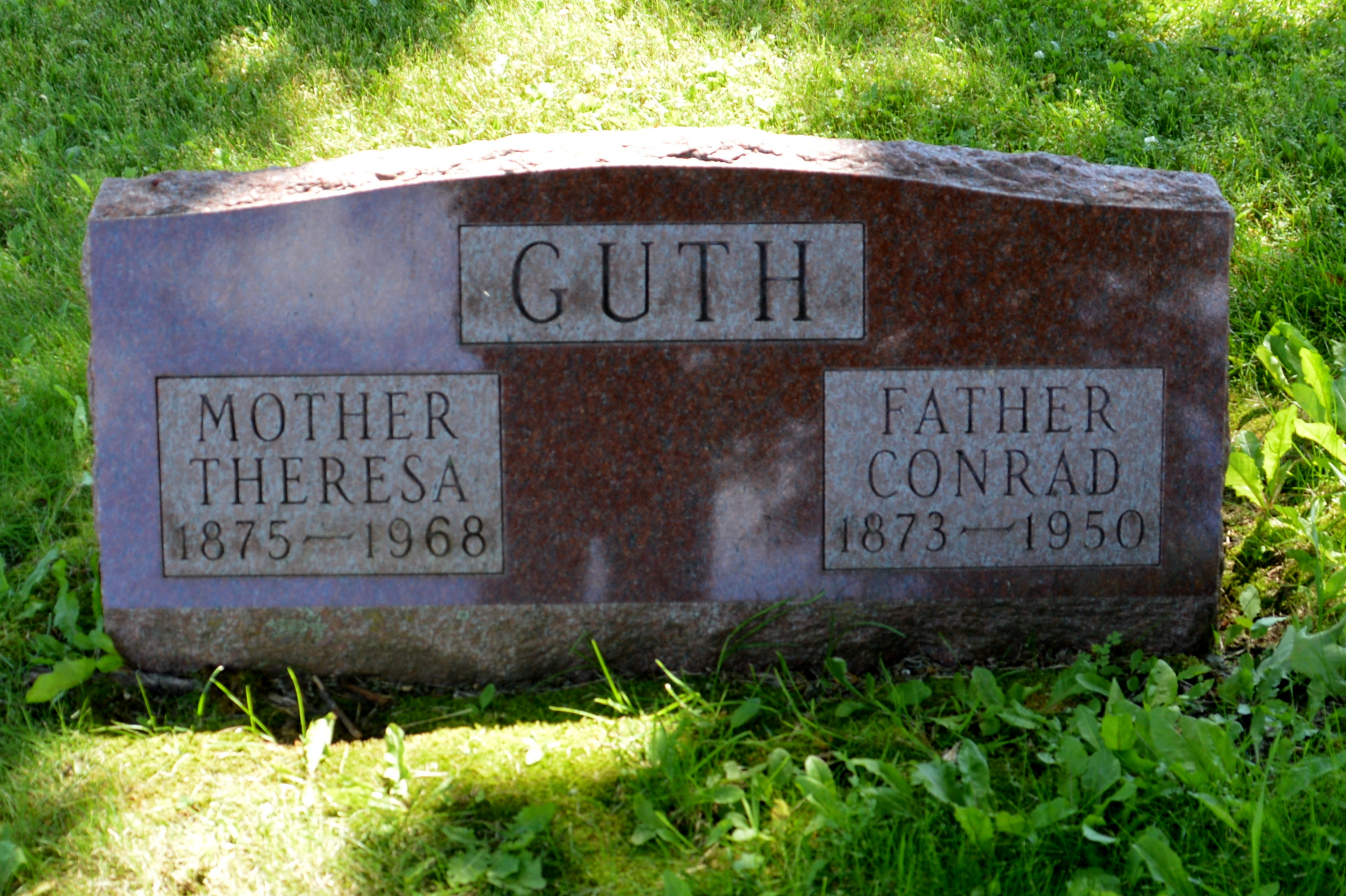
Conrad and Theresa Guth’s grave marker in Algoma, WI. (findagrave.com)
In 1893, he married Theresa Grundemann of the Village of Ahnapee in Kewaunee County, Wisconsin. They had five children. He died in 1950 and was buried in Evergreen Cemetery in Algoma, Wisconsin.
Google image of Kolberg, Wisconsin. C. R. Guth’s store building can be seen at the northwest corner of the intersection at center.
James E. Plummer was born on October 4, 1921 in upstate New York to Clarence and Bessie Plummer. Shortly after he was born, the family moved to Kansas. He was their only child. He enlisted in the United States Army Air Corps on December 7, 1939 as an airplane mechanic. His intention was to learn aviation and work for an airline after his service was completed.
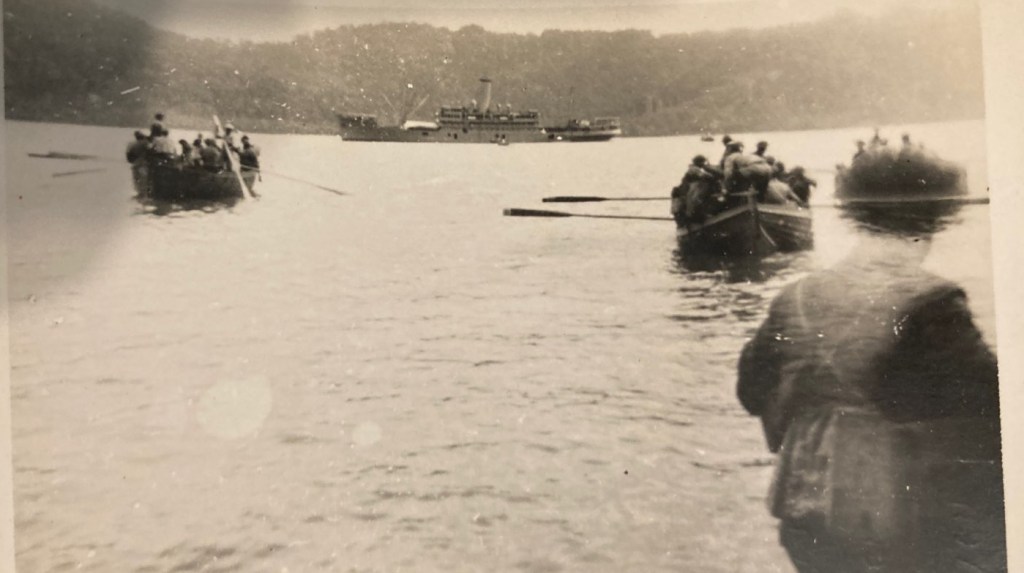
His military service began at Ft. Riley, Kansas where he trained as a mechanic and a tail gunner on B-17s. In the summer of 1941 he transferred to the 19th Bomb Group at Clark Field, the Philippines and was assigned to the Headquarters Squadron. He was at Clark Field when it was attacked by the Japanese on December 8, 1941. He remained at Clark Field until December 29 when the squadron boarded a steamer for Mindanao arriving there on January 1, 1942.
Photograph taken by James Plummer of American troops evacuating the steamer Mayon in Mindanao after it was attacked by Japanese aircraft on January 1, 1942. (Craig Coleman).
The squadron operated out of Del Monte airfield on Mindanao as part of the Visayas-Mindanao Force. Plummer was assigned to the quartermaster depot at Del Monte. In April 1942, he was transferred to an air corps unit responsible for beach defense. On May 7, 1942, the unit removed to Maramig airfield and surrendered to the Japanese. Five days later, Plummer and his comrades were trucked to Malaybalay Prison. He remained there until September 14, 1942 when he was moved to Bilibid Prison at Manila en route to Karenko Prison on the island of Formosa.
James Plummer’s entry (lower right) on the roster of POWs at Malaybaly Prison in the Philippines. (National Archives).
On September 20, 1942, Plummer and approximately 1,000 other POWs were crammed onto the Buenos Aires Maru, an ocean liner that had been converted to a hospital ship to start a seven day journey to Formosa. In addition to its cargo of prisoners, the ship was carrying Japanese soldiers, ammunition and military equipment. The next day, off the coast of Luzon, it was attacked by an American submarine. The Japanese placed armed sentries at the hatch to fire upon any prisoners who tried to flee in the chaos of the attack. They were not provided life jackets. Thankfully, the ship emerged unscathed. (The Buenos Aires Maru was later sunk by American aircraft while transporting Japanese wounded and medical personnel).
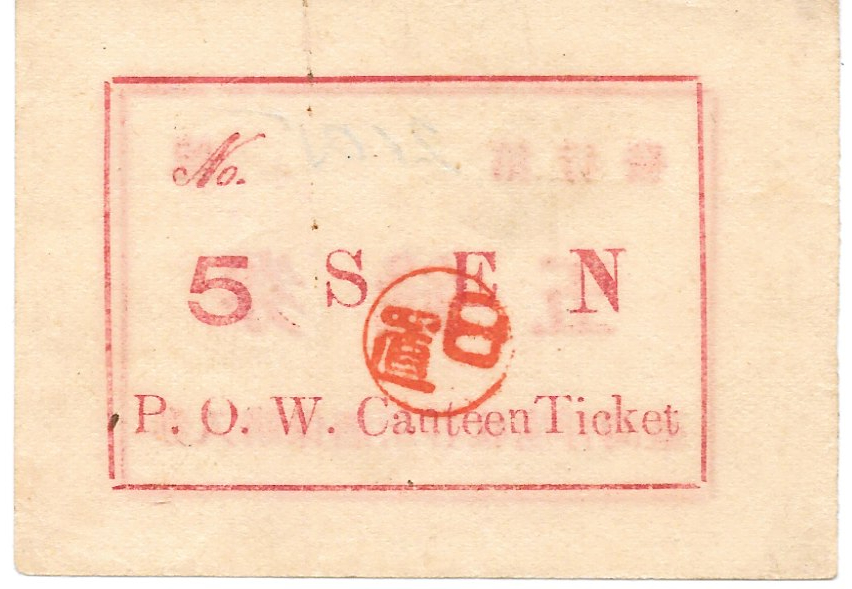
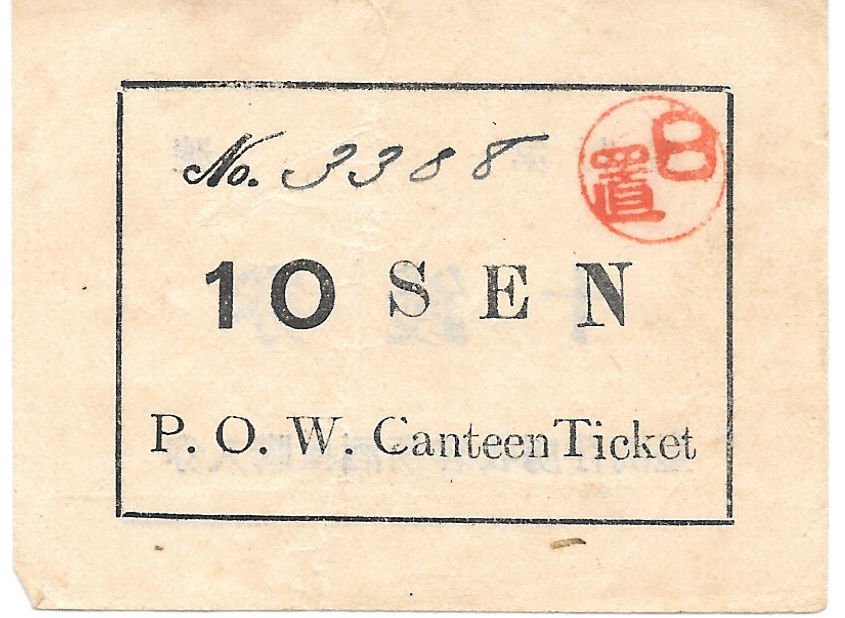
5 sen and 10 sen scrip issued to James Plummer at Shrakowa Camp on Formosa.
Plummer arrived at Karenko on September 27, 1942. He remained there until moved to Shirakowa, Formosa in June 1943. He was at Shirakowa longer than any other facility leaving there in October 1944. While on Formosa, he reported that he was paid five yen per month in camp scrip that could be spent on goods at a poorly stocked camp store.
On October 9, 1944, he and over a thousand other POWs were crammed into the holds of the hellship, Oryoku Maru. They were packed tight and could only sit or stand. The ship had last hauled cattle and the holds were not cleaned. It was infested with rats and cockroaches.
The Oryoku Maru off the coast of the Philippines in October 1943. (US Navy).
Before the ship could leave Formosa it was attacked twice in two days by American Navy planes. The presence of American ships nearby prevented the Oryoku Maru from leaving port until October 22. It arrived at Moji, Kyushu in the Japanese home islands on October 27. The prisoners remained in the holds for those eighteen days. They were let out onto the dock twice during the entire time to where they were hosed down. What little food they were given was passed down from above and not evenly dispensed. Many of the men died or went mad.
(In December 1944, the Oryoku Maru was sunk by planes from the USS Hornet in the Philippines. There were over 3,500 prisoners on board of which 285 were killed in the attack along with over 500 Japanese military and civilians.)
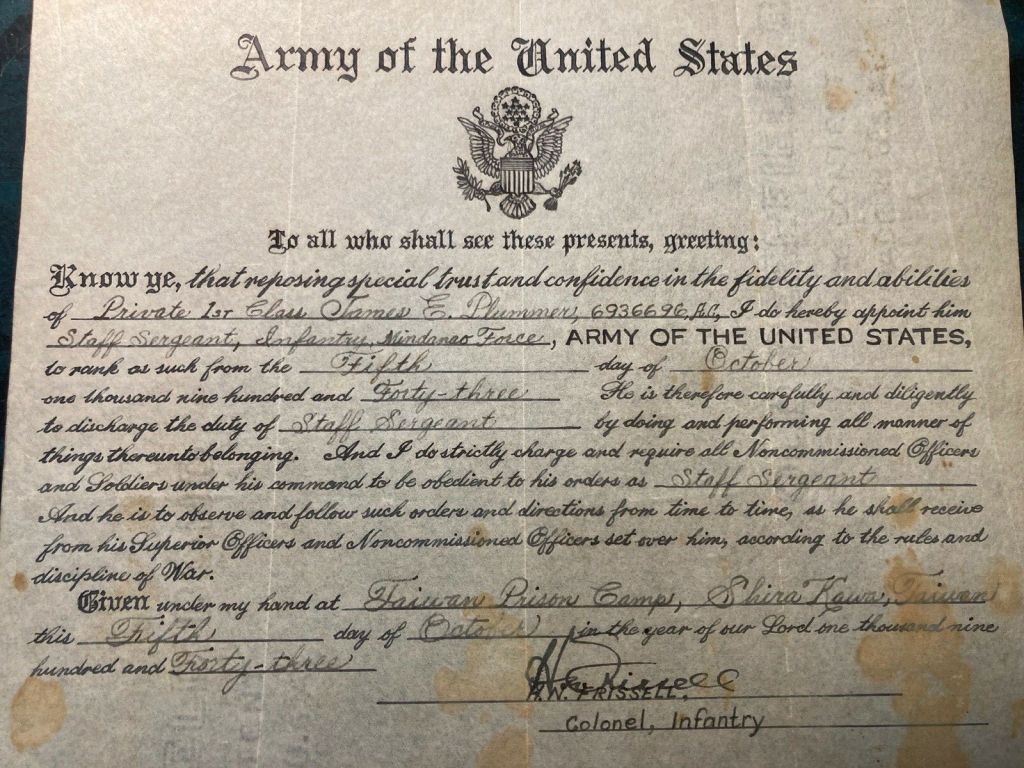
Promotion certificate for James Plummer advancing him from Private First Class to Staff Sergeant while he was at the Shirakowa Prison Camp on Taiwan. (Craig Coleman).
The prisoners were transported from Fusan to a camp in Chiengchia Tun in southern Manchuria. Plummer remained there until May 21, 1945 when he was transferred to the Hoten camp at Mukden in northern Manchuria. Hoten was liberated by the Red Army on August 20, 1945 thus ending 1,285 days of captivity for Sergeant Plummer.
Plummer reported that the best treatment he received as a prisoner was at the camps in the Philippines which were run by the front line Japanese Army units. Camp conditions and treatment of the prisoners by their captors worsened as time went on and he was moved from camp to camp. He did orderly room work for the Allied officers while in the camps on Formosa. He worked in the kitchens of the camps in Manchuria.
Photograph taken in the Mukden Prisoner of War Camp in Manchuria of the announcement of the end of the war. (Original source unknown).
He tended to gardens on Formosa and in Manchuria. The prisoners grew sweet potatoes and cabbage which was intended for their use but was frequently confiscated by the Japanese and Korean guards. The diet consisted almost exclusively of rice and poor quality vegetables. They had meat occasionally early on but it was served less and less frequently until it disappeared altogether. They were able to fish small minnows out of a pond at Mukden.
Discipline in the camps was harsh. The Japanese punished minor infractions by face-slapping. More serious offenses resulted in beatings. Solitary confinement was not used in the camps he was in. Instead, the Japanese instituted punishment by tens. Each prisoner was part of a group of ten and the same punishment was meted out to all in the group. If a prisoner escaped, the other members of his group were executed. Plummer reported only being punished on one occasion. He and two others captured and slaughtered a chicken that had flown into camp at Mukden. This was a violation of camp rules and a guard caught them while it was being cooked. All three men were in separate punishment groups so thirty men served ten days in the punishment pen for this infraction.
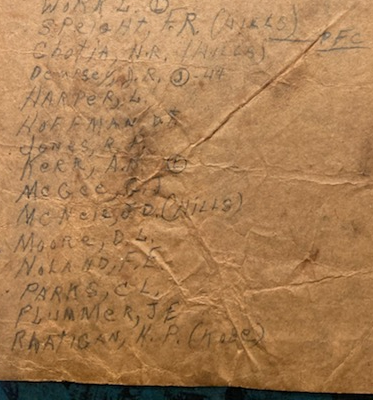
Excerpt of notes taken by James Plummer concerning his fellow prisoners. (Craig Coleman).
Plummer frequently contracted dysentery and had many bouts of malaria. He had one tooth pulled without anesthetic while in the camps. After liberation, he had another tooth pulled and twenty fillings put in. He lost thirty pounds during captivity. He suffered from nervousness and his eyes were failing. He was evacuated to the 204th General Hospital on Guam where he remained for recuperation until early 1946. He was eventually discharged on May 27, 1946.
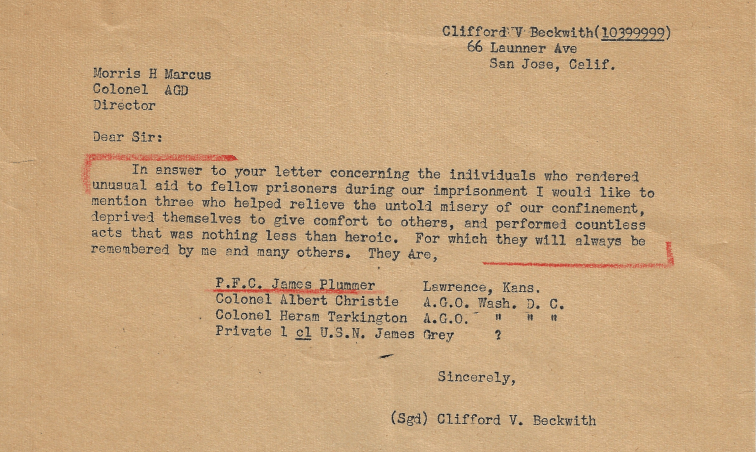
Letter from fellow prisoner Clifford V. Beckwith commending James Plummer for actions in aid of his comrades while in Japanese captivity. (Craig Coleman).
He returned to Kansas after the war. While he did not see his dream of working in aviation realized, he became a construction project manager for a company that did work all around the world. Ironically, two of the places he worked were Mindanao and Manchuria. He died in Kansas in 1996.
The source for this information was James Plummer himself. He answered a questionnaire about his imprisonment in 1946. He also gave an interview to a sixth grade neighbor in 1985 for a class project. I am indebted to Craig Coleman for providing me copies of these documents as well as other records kept by Sgt. Plummer.
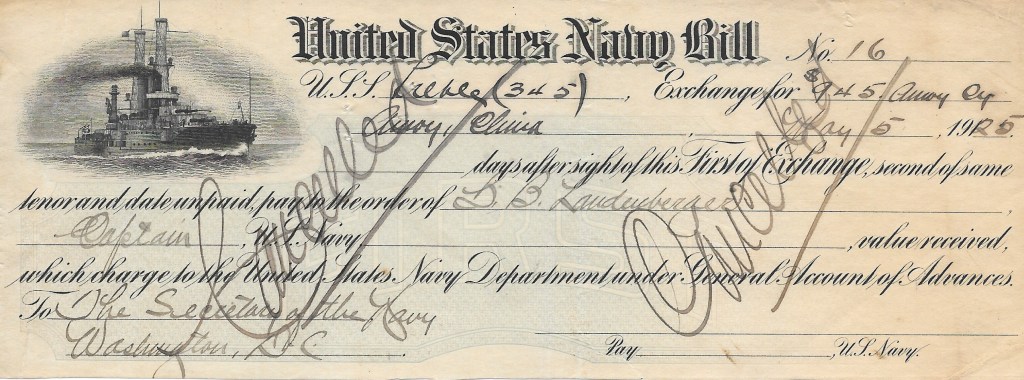
This Bill of Exchange was made out in May 1925 on the USS Preble when it was with the Asiatic Fleet. It was made payable to Captain George B. Landenberger. Capt. Landenberger was commander of the Asiatic Fleet’s Destroyer Squadron. His command ship was the USS Black Hawk.
George B. Landenberger as Governor of Samoa. (US Navy)
He received the Navy Cross in WWI for his service as commander of the USS Indiana. He was in charge of the Receiving Station at San Francisco before and after his service in China. He later served as Governor of American Samoa. He died in 1936.
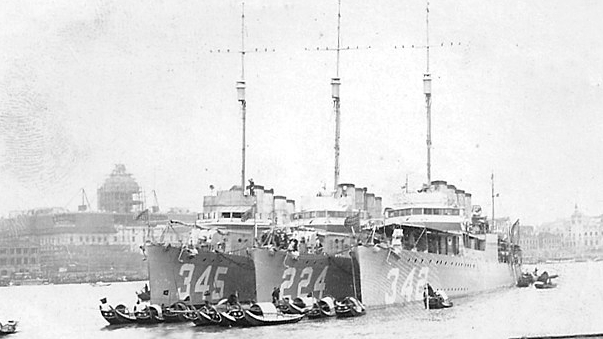
USS Preble, USS Stewart and USS Hurlburt at anchor in Shanghai in 1927. (US Navy)
USS Preble was a Clemson class destroyer launched in 1920. It was named for Commodore Edward Preble. It served in the Caribbean and Atlantic until 1921 when it joined the Asiatic Fleet at Chefoo, China. It spent the next several years patrolling from Manchuria to Burma. It participated in escort and patrolling duty on the Yangtze from 1927 to 1929 when it returned to the US and operated out of San Diego and Mare Island. It served in the Pacific during WWII and earned eight battle stars. It was scrapped in 1946.
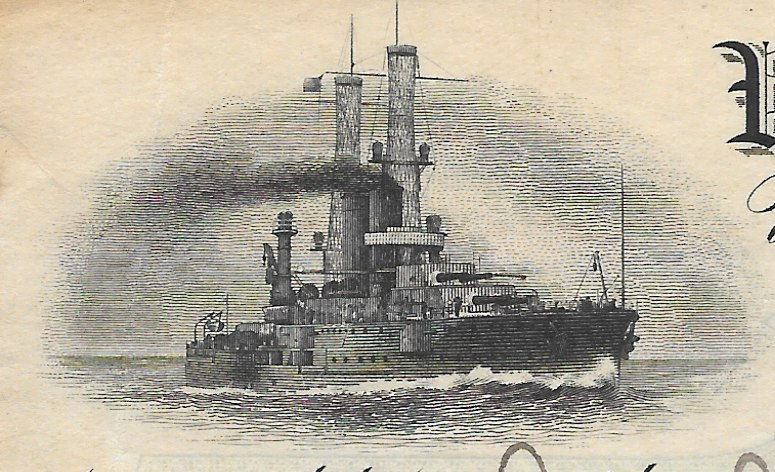
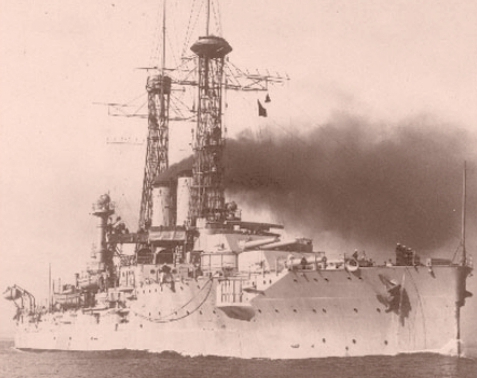
A close up of the vignette on the Bill of Exchange from the USS Preble and a picture of the USS Utah. (US Navy).
The Bill of Exchange was commercially printed and not made by the United States Bureau of Engraving and Printing. It was printed in the 1910s but still in use in 1925. The vignette is lithographed and is based on one of the Florida class battleships, either the USS Florida or USS Utah.
Map of Amoy from 1915. (Imperial Japanese Railway).
The Bill of Exchange was written for 945 dollars in Amoy currency. The port of Amoy is now the city of Xiamen, China. It lies on the Chinese coast between Shanghai and Hong Kong directly across from Taiwan.
Amoy currency was not a physical coin but a unit of account. It was based on the Spanish Milled Dollar and its value was determined by the Amoy branch of the Hong Kong and Shanghai Banking Corporation. All foreign trade in China was done in silver. Foreign trade dollars including the Spanish Milled Dollar, Mexican Peso, US Trade Dollar and British Trade Dollar were used. All of these were of different fineness and composition. Chinese dollars and subsidiary coinage was introduced in the early 20th Century. The coinage system was very complicated and resorting to Amoy currency as the exchange medium brought stability to commercial transactions.
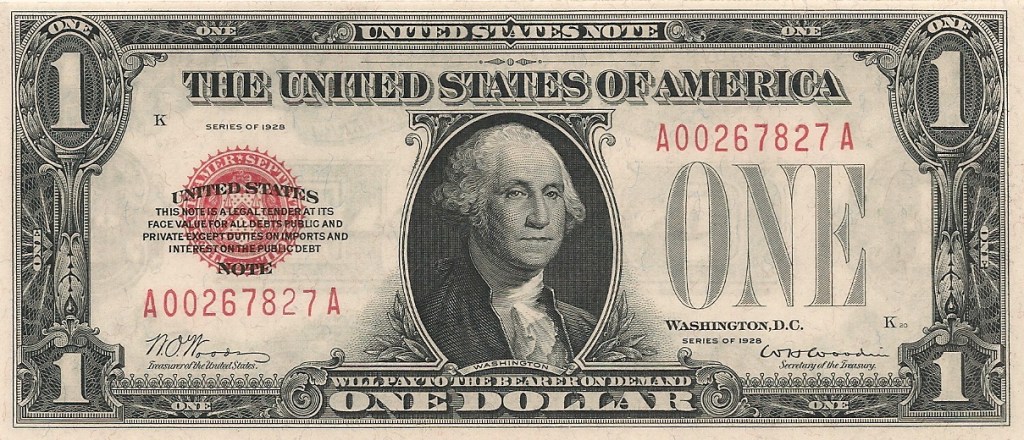
The 1928 $1.00 United States Note was the first US small size currency. US paper money has changed little since then.
Shortly after his inauguration, President Biden announced that the US government would re-start the process of replacing Andrew Jackson on the $20.00 bill with Harriet Tubman. The announcement re-kindled a debate as to whether the change was appropriate. I am not going to re-hash the arguments here.
My position is that I do not really care (within reason) what images grace the money of the United States. I do, however, feel that US paper money is in dire need of an overhaul. The images are stale and have not really been changed in almost 100 years. (I do not count the recent changes as being significant).
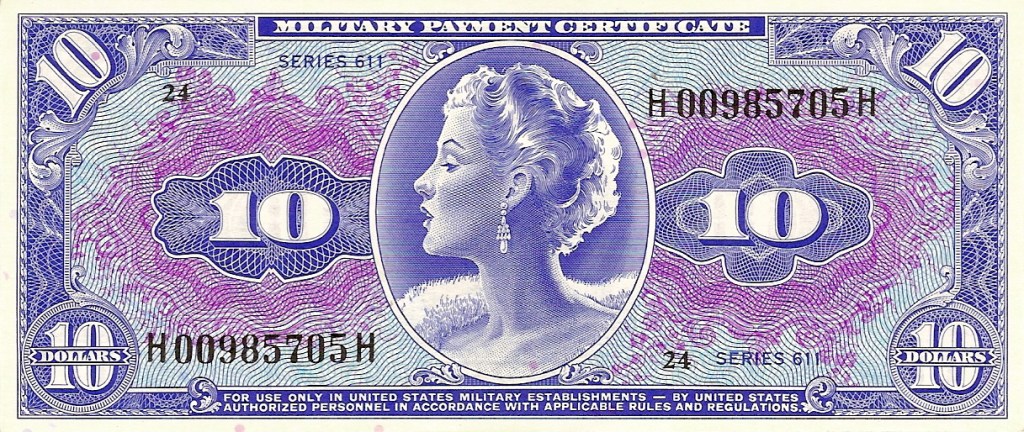
The Series 611 $10.00 US Military Payment Certificate is one of the most attractive notes made by the United States Bureau of Engraving and Printing. The note was largely unseen by Americans as it was only used in Vietnam.
A nation’s currency should be a reflection of the nation itself. It should showcase the country’s history, culture, geography, arts, sciences, etc. One of the unfortunate effects of the introduction in the euro or the adoption of the US dollar in Ecuador is that paper money no longer serves as a mirror for the values of the countries in which it is used.
To advance my position, I am going to show examples of images of notes from other countries to illustrate what US paper money could look like.
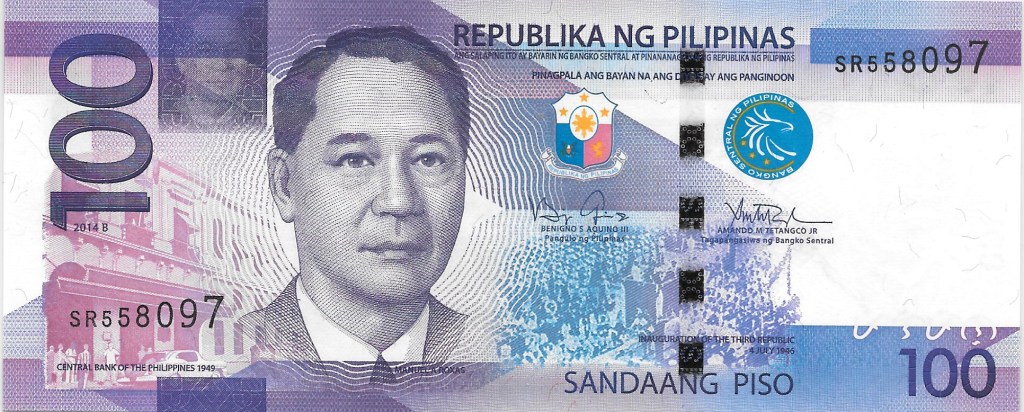
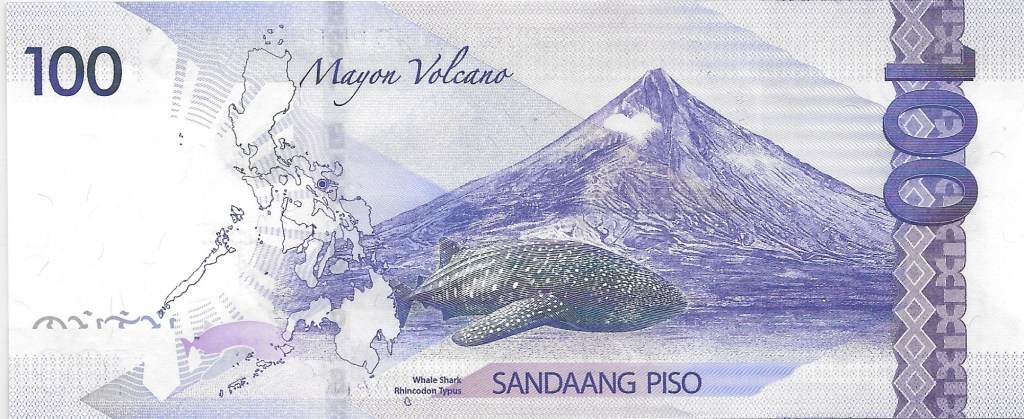
Philippines 100 Piso
The current Philippine 100 piso note has a myriad of images on its face. While the predominant feature is a portrait of former president Manuel Roxas, the background images include the facade of the Central Bank of the Philippines and a street scene from Manila from celebration of Philippine independence on July 4, 1946.
The back of the note is dominated by a landscape showing the Mount Mayon volcano. Also depicted is whale shark leaping from the water.
Sweden 100 Kronor
The Swedish central bank, the Riksbank, recently changed the designs of their notes. While the 1000 kronor note depicts a government official, former UN Secretary-General Dag Hammerskjold. the depictions on the other notes are all associated with the arts and include authors, musicians and motion pictures.
The central image on the face of the 100 kronor note is actress Greta Garbo. (Ingmar Bergman is on the 200 kronor note.) The back of the 100 kronor note shows a view of the city of Stockholm. It was chosen because Garbo was from Stockholm.
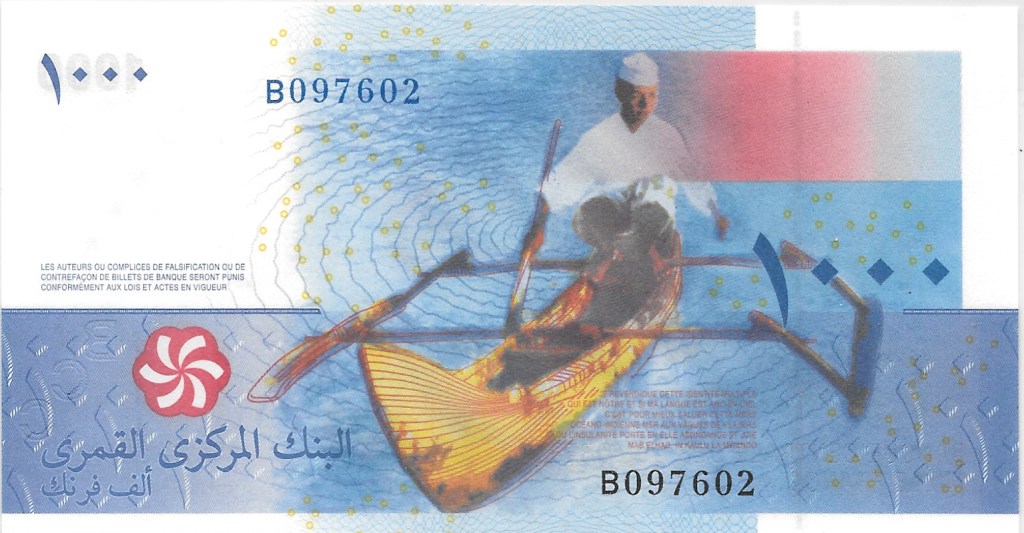
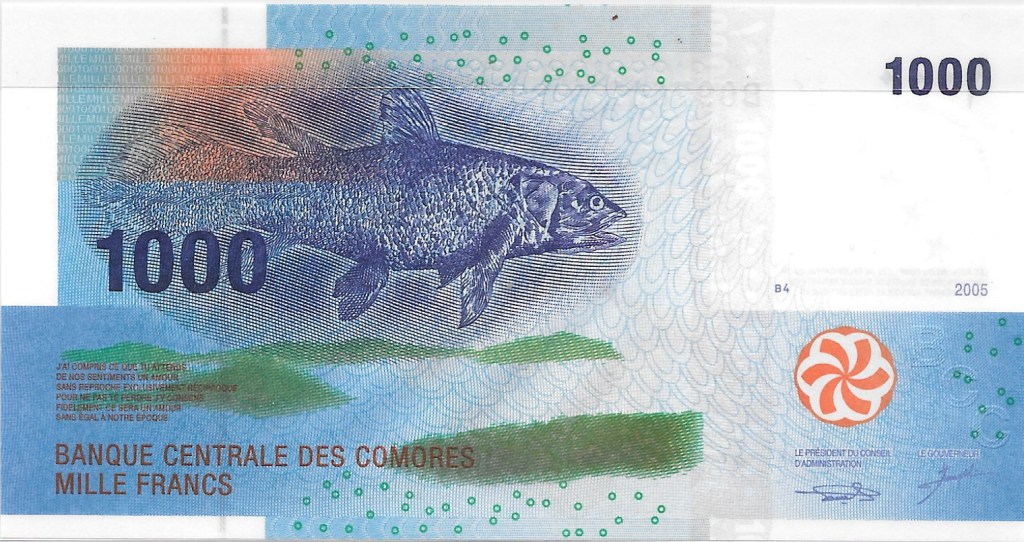
Comoros 1000 Francs
The Comoros are an island nation in the Indian Ocean lying northwest of Madagascar and east of Mozambique and Tanzania. The 1000 franc notes depicts a fisherman in an outrigger on the face. On the back is an image of a coelacanth.
The coelacanth is a lobe finned fish that is only found in the Indian Ocean. It was thought to have been extinct for 65 million years based on fossils found in the 19th century. It was re-discovered in 1938 when one turned up in the catch of a fisherman in South Africa.
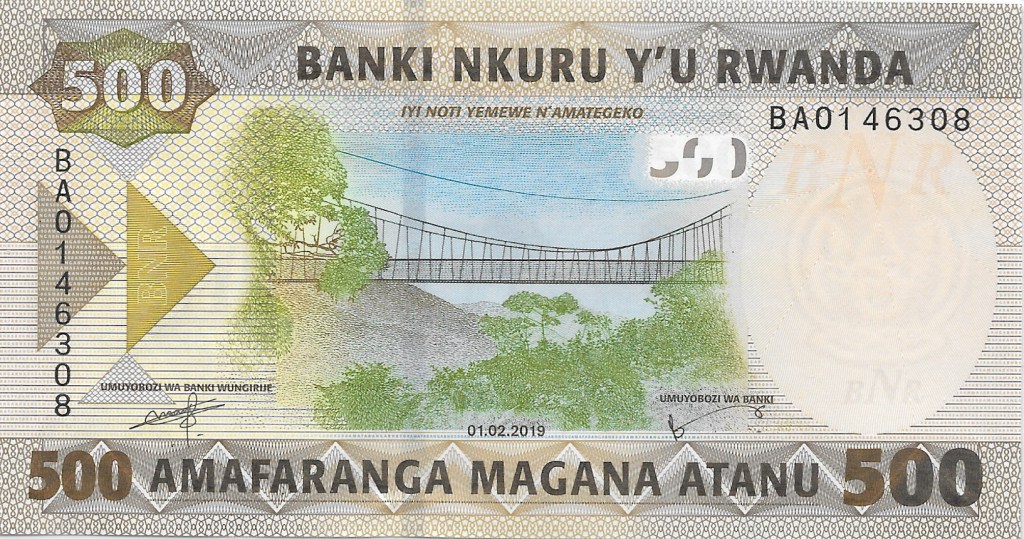
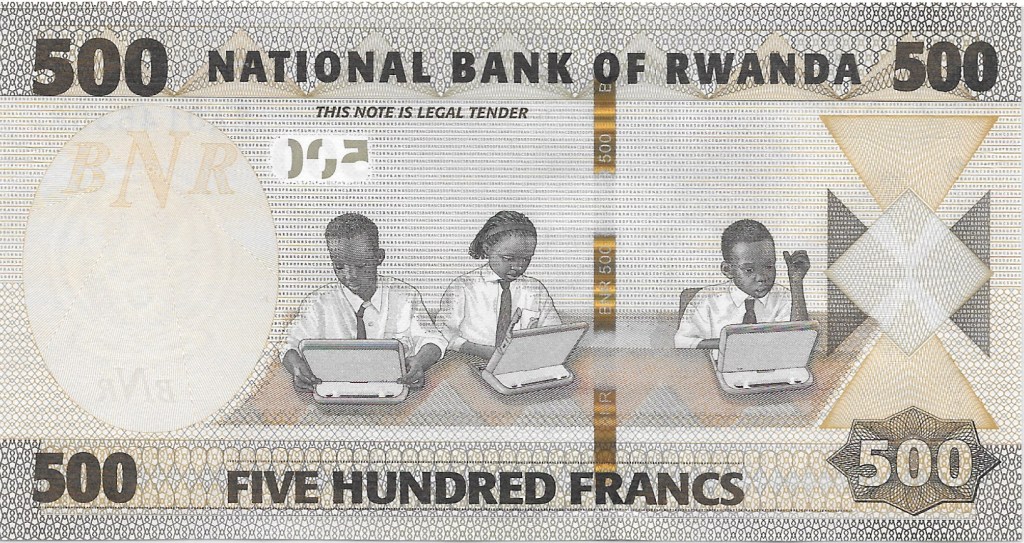
Rwanda 500 Francs
In 2019, the National Bank of Rwanda issued a new 500 franc note. The previous note depicted diary cows on the face. (Holsteins, in fact). The new image on the face is the Muregeya suspension bridge. The bridge was completed in 2015 and links two sides of the Muregeya River giving the inhabitants of the neighboring districts greater access to markets and resources.
The back of the note depicts Rwandan schoolchildren working on XO laptops. The government of Rwanda invested heavily in the XO computer beginning in 2008 with a goal of providing a laptop for every child in the country. The country recently changed to a different provider, Positivo, which has opened a factory in the country.
Brazil 10000 Cruzeiros
In 1991 the Central Bank of Brazil introduced a 10,000 cruzeiro note. The country was in the grips of rapid inflation. The cruzeiro was introduced in 1990 and was replaced in 1993.
The face of the 10,000 cruzeiros note depicts Brazilian scientist, Vital Brazil. Brazil was world-renowned for his development of antidotes for snake venom. In addition to the portrait of Brazil, the face of the note has an image of a snake being milked for its venom. A security feature on the note is a face to back registration of an image of the head of a snake with the venom glands highlighted.
Herpetology continues on the back of the note with a depiction of a snake devouring another.
These are just a few examples of how other countries highlight their history and culture on their banknotes. Surely, the United States can do better.
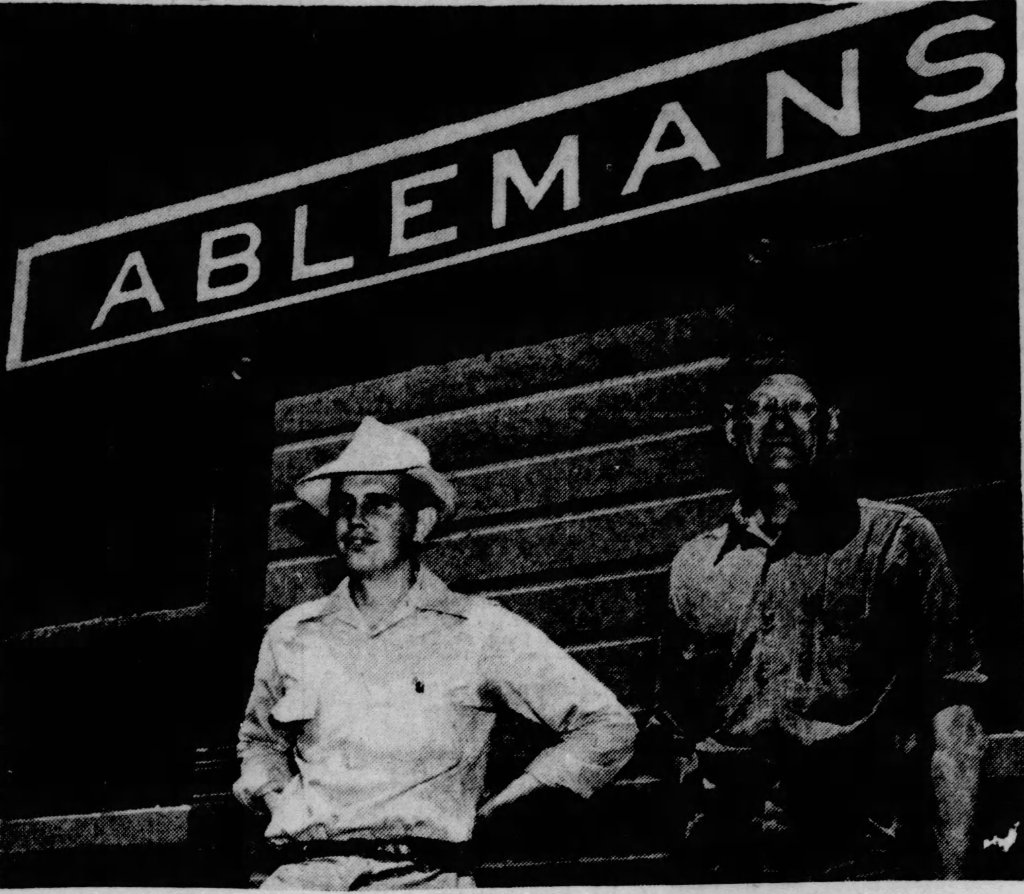
Postmaster Art C. Finder changing the sign at the Ableman Post Office to Rock Springs on July 2, 1947. (The Capitol Times).
Rock Springs, Wisconsin is a small village in Sauk County in the south, central part of the state. It comprises all of 1.5 square miles and has a population of about 350. The original name of the community was Ableman, being named for its founder Stephen Van Rensselaer Ableman.
The 1880 History of Sauk County describes the area in glowing terms: “The place is beautifully situated at the base of the famous Baraboo quartzite range, in full view of the romantic and wonderful spot known as the Upper Narrows. The surroundings are cheerful and grandly picturesque.”
The Ableman railroad station on the morning of July 2, 1947. The Chicago Northwestern gave no direction to the station master to change the sign. Lost to history is the additional S on the sign. (The Capitol Times).
Ableman moved to western Wisconsin from New York in 1851. He mapped out the community in 1853. He chose the location based on topography, recognizing that it would be the most probable location for a railroad.
Ableman served as the area’s first postmaster. The post office was established in 1871.
In 1875, the community changed its name to Rock Springs. The name is a reflection of the hundreds of natural springs that emerge from the rock formations nearby. In 1879, the village went back to being called Ableman.
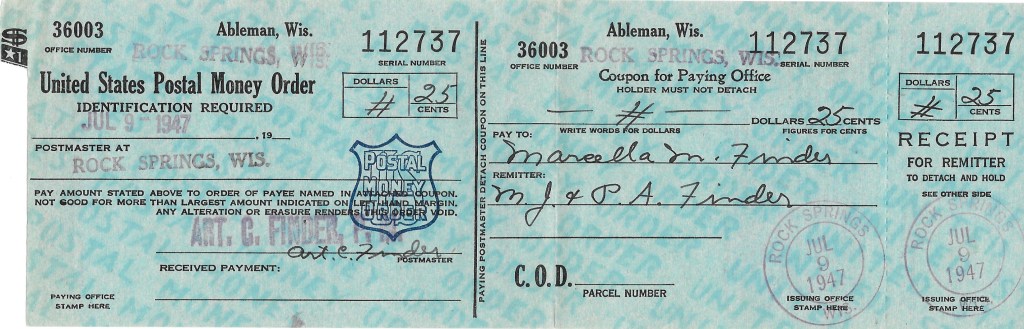
Postal money order issued July 9, 1947 from the post office at Rock Springs, Wisconsin. The money order is signed by Postmaster Art Finder. It is payable to his wife, Marcella. The remitters are his daughters Mary J. Finder and Patricia Ann Finder. Finder reported that the USPS had not sent him any necessary items before the official change on July 2, 1947. In this case, it was the rubber stamp to change the name on the money order forms.
In 1946, the local Chamber of Commerce began a drive to change the name once again to Rock Springs. Over 95% of the community supported the change. Final approval for the name change came from the United States Post Office and on July 2, 1947, it was Rock Springs once again.
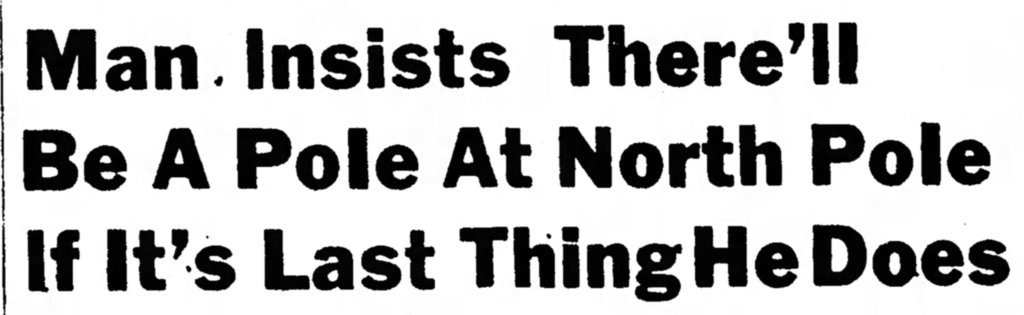
Headline from the September 20, 1961 Statesville (NC) Record and Landmark.
Mid afternoon on December 11, 1951, an Alaska Airlines DC-4 nicknamed “The Polar Express” took off from Fairbanks and returned some 16 hours later accomplishing something no other commercial airliner had accomplished before — flying over the North Pole.
The flight was a publicity stunt, but one with the very important purpose of placing a literal pole at the North Pole. The scheme was the brainchild of Stanley Garson, an oil worker in Point Barrow. He constructed a nine foot long, red and white striped pole to be placed on the top of the world. Garson enlisted the help of Alaskan radio personality Audree Vance whose broadcast name was North Pole Nellie. Nellie suggested that the flight also carry children’s letters to Santa.
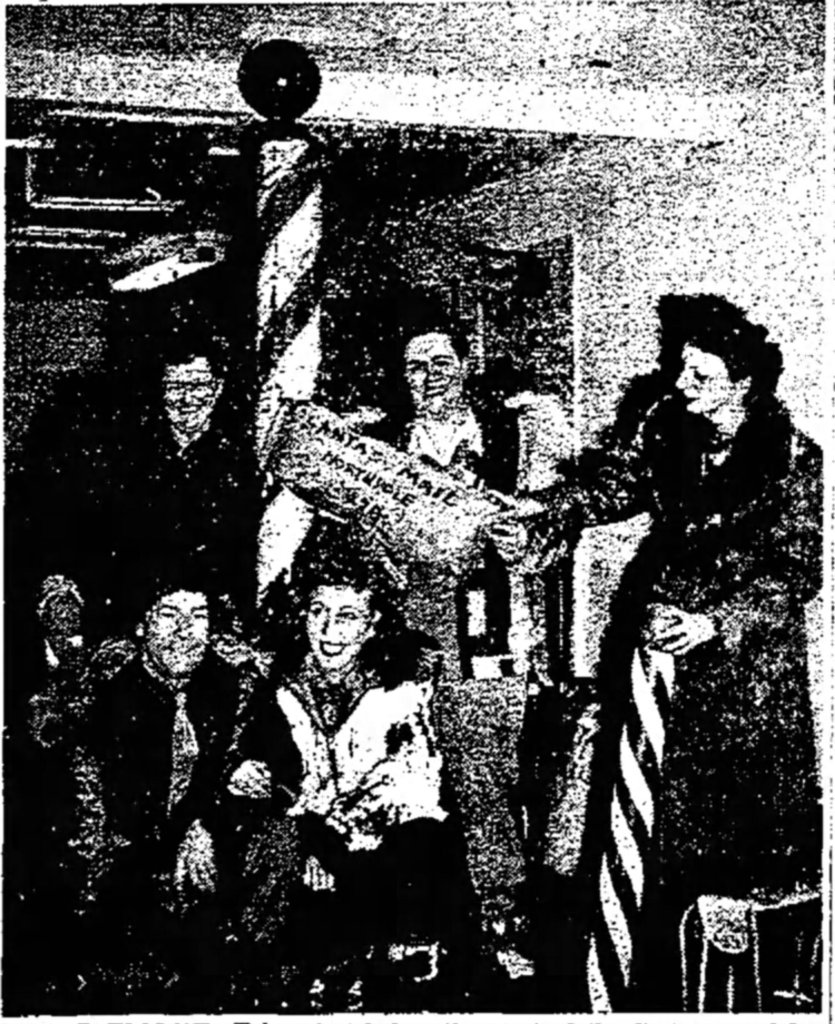
Fairbanks Mayor Bob Hoopes and Carolina Cotton (lower left) and North Pole Nellie (holding the mail bag at center) prepare for the flight of the Polar Express. (Fairbanks Daily News-Miner).
The original hope was that the US Air Force would deliver the pole and the letters. The Air Force frequently made flights from Ladd Air Force Base over the pole. The nine foot pole was too large for the Air Force to transport so it was cut down to six feet. The plan, however, was ultimately rejected by the Air Force.
Nellie pitched the idea to Alaska Airlines who jumped at the chance. By mid-November 1951, the Civil Aeronautics Board approved the flight which was planned for Thanksgiving. Delays pushed it into December.
In the meantime, Nellie turned up the PR campaign. She was even able to get Hollywood to help. The film industry was beginning a publicity campaign of its own called “Movietime USA” and were eager to help. A young actress named Carolina Cotton (the Yodeling Blonde Bombshell) was sent as their contribution to the event.
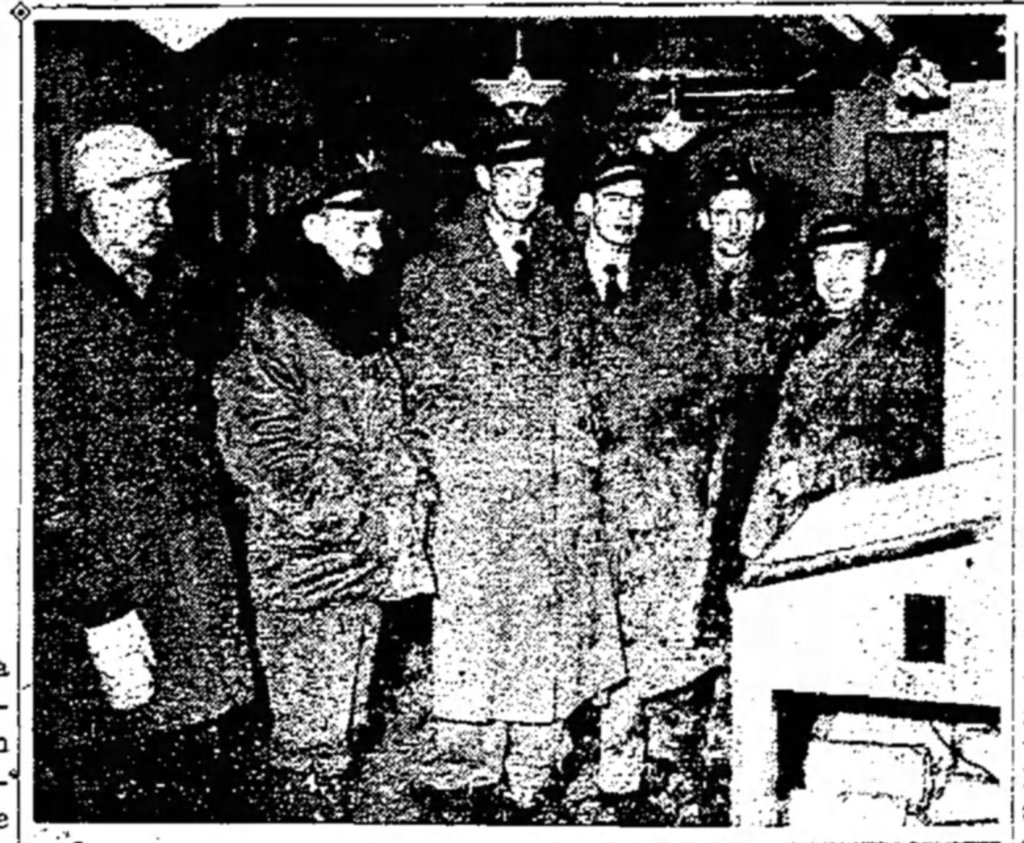
The flight crew (from left to right): Robert Kong (2nd pilot), Wayne Wisting (chief navigator), Daniels McClean (Navigator), Charles Hall (3rd Pilot), Hebry O’Neil (flight engineer), L.E. Flahart (Captain). (Fairbanks Daily News-Miner).
The date of the flight was moved to December 10. A parade from the post office to the airport was held sponsored by the Alaskan Dog Mushers Association. The plane, however, was in Seattle and delayed by maintenance. It arrived the next day.
The letter writing campaign met with overwhelming success. The original plan was to put the letters inside the pole. More than 5,000 letters were received which exceeded the poles capacity. The others were placed in a bag and tied to the pole.
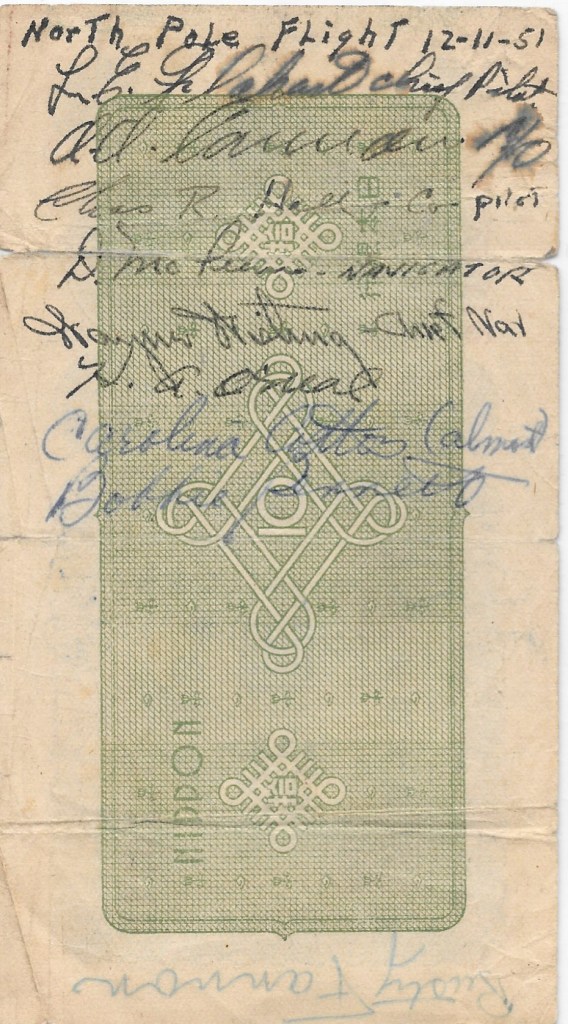
Short snorter on a Japanese 10 yen note commemorating the flight of the Polar Express on December 11-12, 1951. In addition to the crew, the note is signed by Carolina Cotton, her manager Bobby Bennett and ground crewman Rusty Fannon.
Shortly after noon on December 11, the plane left the Fairbanks airport to great fanfare and good luck kisses for the crew from Ms. Cotton. They re-fueled at an Air Force installation at Point Barrow and headed for the Pole. As they approached the target, a new problem surfaced. The pole was too large to fit through the side door of the plane. With some last minute modifications, everything was set.
With the ice caps in sight, the pilot reduced speed to 120 mph. The side doors were opened and the pole and the bag of letters were deployed. Its chute opened and the pole drifted slowly downward lit by a flashlight tied to it as a beacon. At 12:58 am on December 12, 1951, there really was a pole at the North Pole.
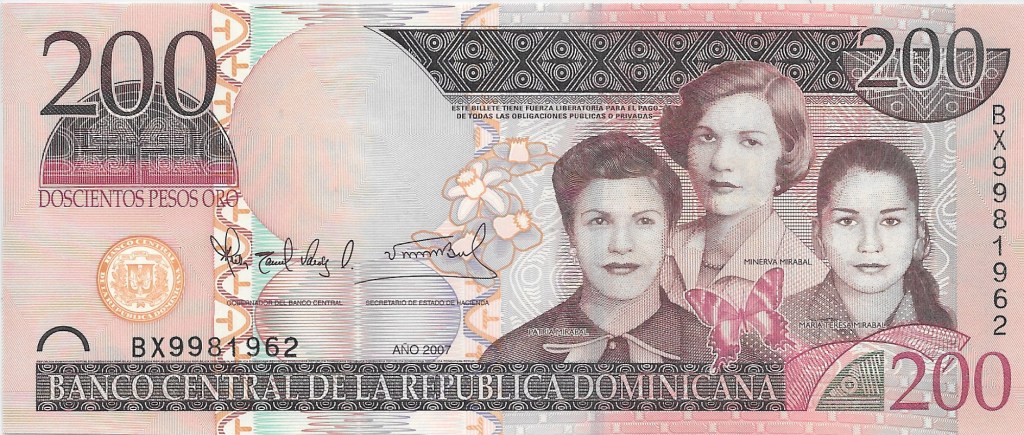
This past week marked the International Day for the Elimination of Violence Against Women. The day was first observed by UN Resolution on November 25, 1999. The date marks the martyrdom of the Mirabal sisters — Patria, Minerva and Maria Teresa — at the hands of the Trujillo regime in the Dominican Republic. This year marked the 60th anniversary of their deaths.
The women, along with a fourth sister, Dede, were the children of Enrique Mirabal Fernández and Mercedes Reyes Camil. They were raised on the family farm in the central part of the Dominican Republic.
The Mirabal sisters as they appear on the 200 peso note from the Dominican Republic.
Minerva became involved in the political movement against the Trujillo regime while she was in college. Trujillo and his minions ruled the Dominican Republic from 1930 until 1961.
Maria Theresa and Patria joined in their sister’s anti-government activities. They joined a group known as the Movement of the Fourteenth of June. They distributed leaflets about the abuses of the Trujillo regime. They also sought weapons to defend themselves against the military and for open revolt.
Minerva’s code name with the Movement was “butterfly” (mariposa in Spanish). After Patria and Maria Teresa joined, they were collectively known as “Las Mariposas”.
Minerva and María Teresa were arrested and imprisoned along with their husbands and Patria’s husband. The women were freed in 1960 but their husbands remained incarcerated.
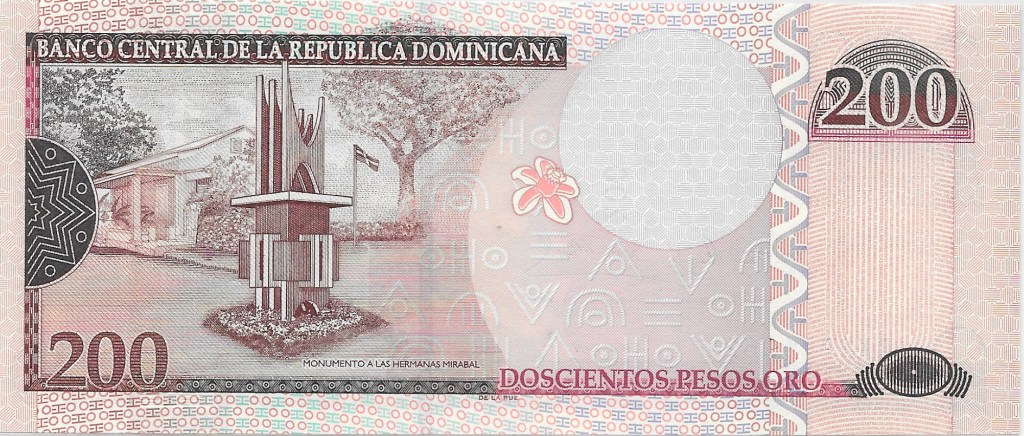
Monument to the Maribal sisters outside the family home in the Cibao region of the Dominican Republic.
On 25 November 1960, Patria, Minerva and Maria Teresa were visiting Maria Teresa and Minerva’s husbands in prison. On the way home, they were captured by government operatives. The sisters and their driver were strangled and beaten to death. The bodies were placed in a Jeep and run off a mountain road to appear as an accident.
Their nemesis, Rafael Trujillo, met a similar fate when he was assassinated on March 30, 1961.
The surviving sister, Dede, raised her nieces and nephews and spent the rest of her life preserving the memories of her sisters. She lived in their parent’s house until her death in 1988.

.jpeg)
.jpeg)












 Numismatic Notebook