Scandinavia Academy

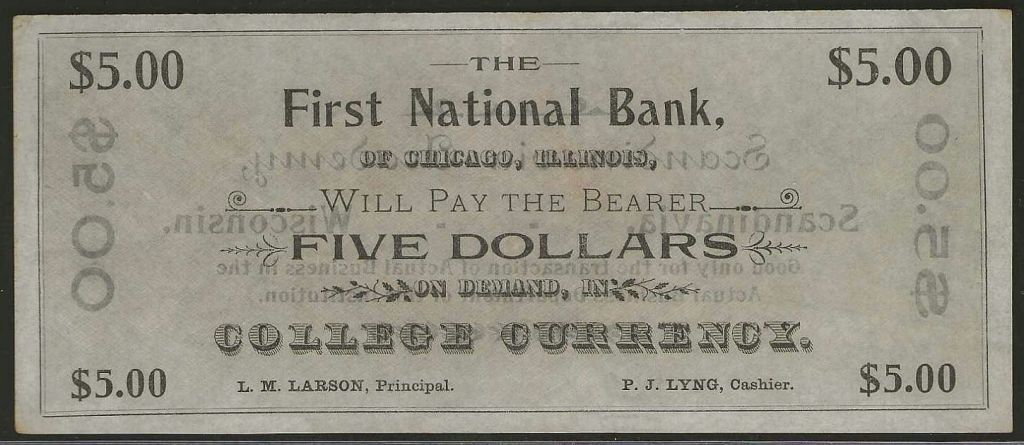
College currency is a type of practice paper money that at one time was used in business training schools. Most college currency dates from the late 19th Century. Many different schools printed college currency. The different types were cataloged by Herb and Martha Schingoethe in their 1993 treatment, College Currency, Money for Business Training.

The above note was printed for use in the Scandinavia Academy of Scandinavia, Wisconsin. The Academy was founded in 1891 by the United Lutheran Church in the small, central Wisconsin town in Waupaca County. The school’s first building was dedicated on Reformation Day in 1893 and opened for classes on November 1.
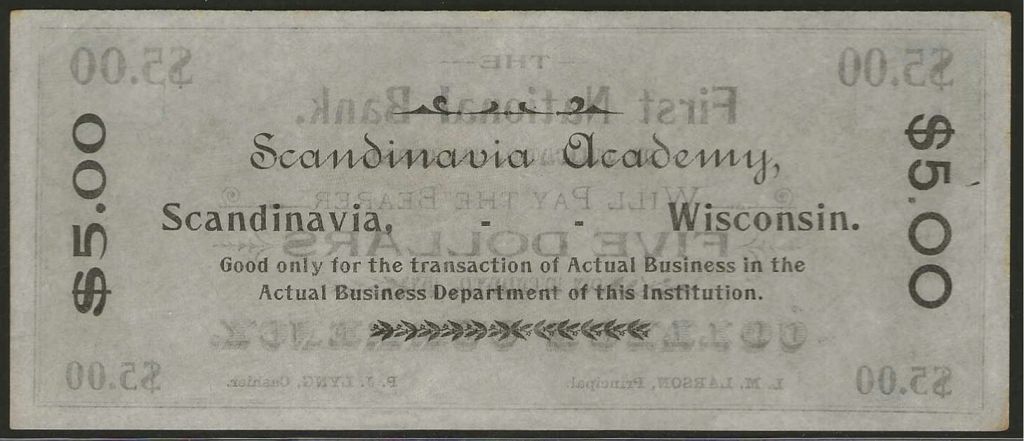
The school was to be an “educational institution on the High School plan, also offering a Business Course, whose atmosphere and general management should be permeated with christian principles and be conducive of a healthy and moral growth to those who should frequent the school.”

The original school building burned in 1919. It was rebuilt in 1921 and the curriculum was enlarged to include junior college classes. The name was changed to Central Wisconsin College to reflect this. That institution closed in 1932. The buildings then housed the local Union Free High School and are still standing.
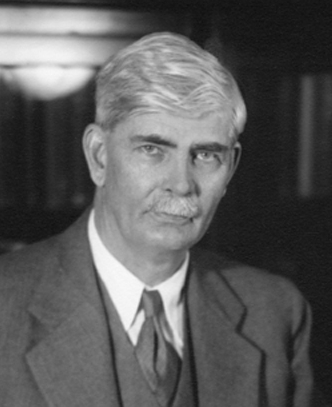
Laurence M. Larson (Source: University of Illinois)

The note identifies L.M. Larson as Principal and P.J. Lyng as Cashier. Laurence M. Larson was named the school’s principal in 1894. Larson was a Norwegian immigrant who attended Drake University. He left the Academy to attend further studies at the University of Wisconsin. In 1907, he was made a professor of history at the University of Illinois where he finished his academic career. He was a prolific writer concentrating on Medieval Norse and English history.

Peder J. Lyng (Source: ancestry.com)

Peder J. Lyng was a graduate of the initial class from Concordia College in Moorhead, Minnesota in 1893. He was hired in 1894 to head the Commercial Department (the business school) at Scandinavia Academy. Tragically, he died in January 1895 at his home in Waupaca.

Lyng’s brief tenure at the school narrows the date of printing of the notes. In addition to the $5.00 note, a 50 cent and $1.00 note are also known. The 50 cent note is somewhat peculiar in that it is the same size as the higher denominations and fractional currency had ceased being printed in the United States in 1876.
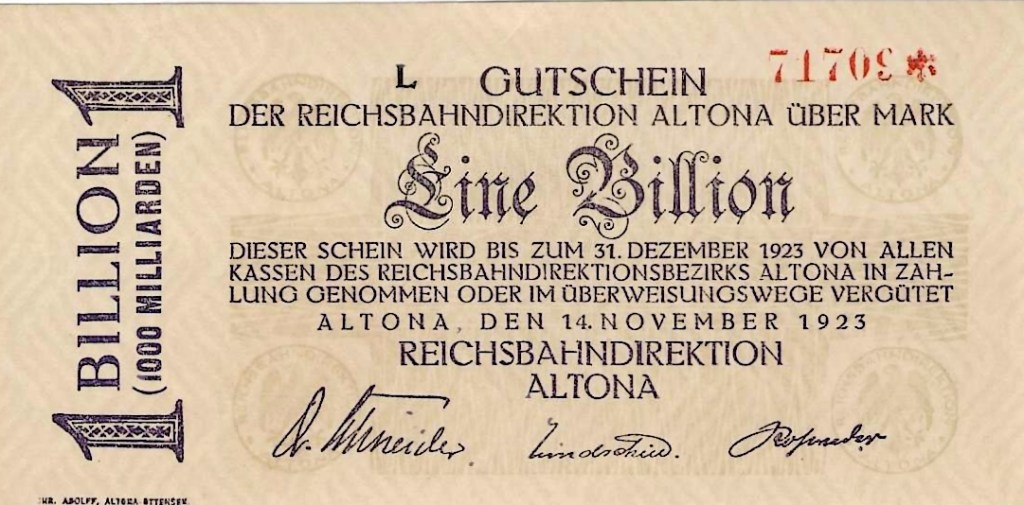
A Billion Here is not A Billion There

One billion mark note issued by the German railway office at Altona in November 1923. Note the reference to one billion being equal to 1,000 milliarden.

In the early 1920s, the German economy began to teeter under the weight of the obligations imposed on the country by the Treaty of Versailles. Germany’s reparation payments had to be paid in hard currency. Starting in 1921, the Reichsbank began printing more and more paper marks in order to buy up the foreign exchange necessary to meet its treaty obligations. Inflation began to rapidly force up prices in Germany into 1922. The mark declined to 160 to a US dollar.

Germany was unable to meet its reparations payments in late 1922. In response, French and Belgian troops occupied the Ruhr valley — the industrial heat of Germany — to ensure Germany met its obligations. The German government ordered a general strike in response to the occupation. The striking German workers continued to paid but the only way to raise the cash to pay their wages was to print more marks.

Ten billion mark note issued by the German railroad office at Karlsruhe. The denomination is the highest issued during the German hyperinflation of 1923.

These factors, coupled with the weakened state of the German economy, brought hyperinflation in 1923. At its peak in November 1923, the dollar exchange was 4,210,500,000,000 marks.

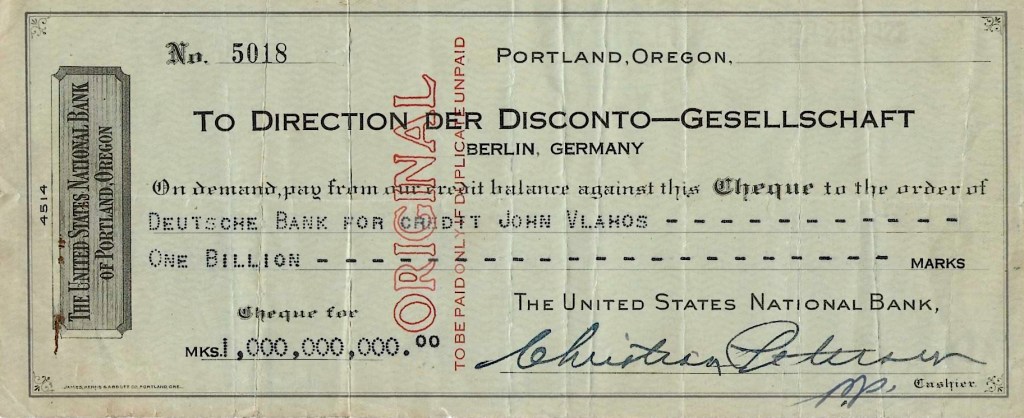
Draft drawn on the Deutsche Bank from the foreign exchange office of the United States National Bank of Portland, Oregon from November 1923. While the value is written as one billion in words, the German bank would have read the numerical value not as one billion but as as one milliarden, a thousand times less than one billion.

The hyperinflation necessitated the printing of higher and higher denomination notes. The face amount of banknotes and other instruments quickly went through the millions and into the billions of marks. Reichsbank notes topped out at 10 billion marks.

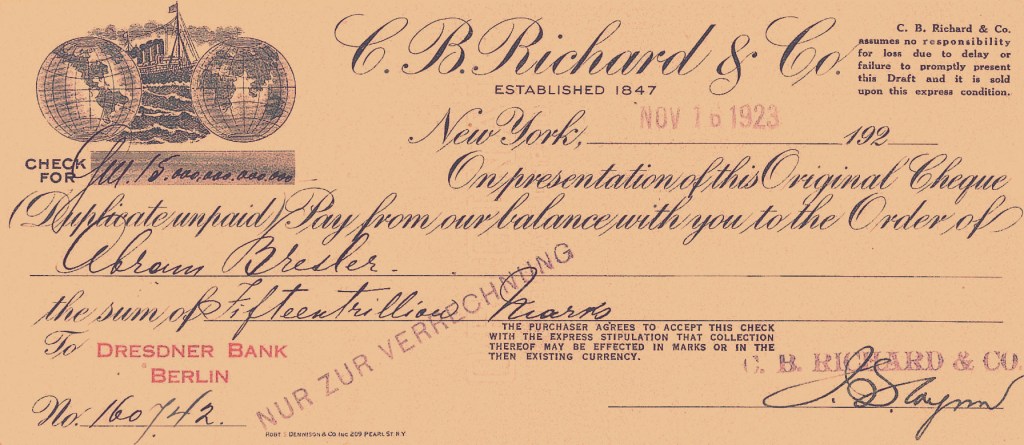
Check written in Novemnber 1923 on the Dresdner Bank in Berlin for 15,000,000,000,000 marks. This would only be 15 billion marks to a German. The exchange rate meant the drawer paid about US$3.75 for the check.

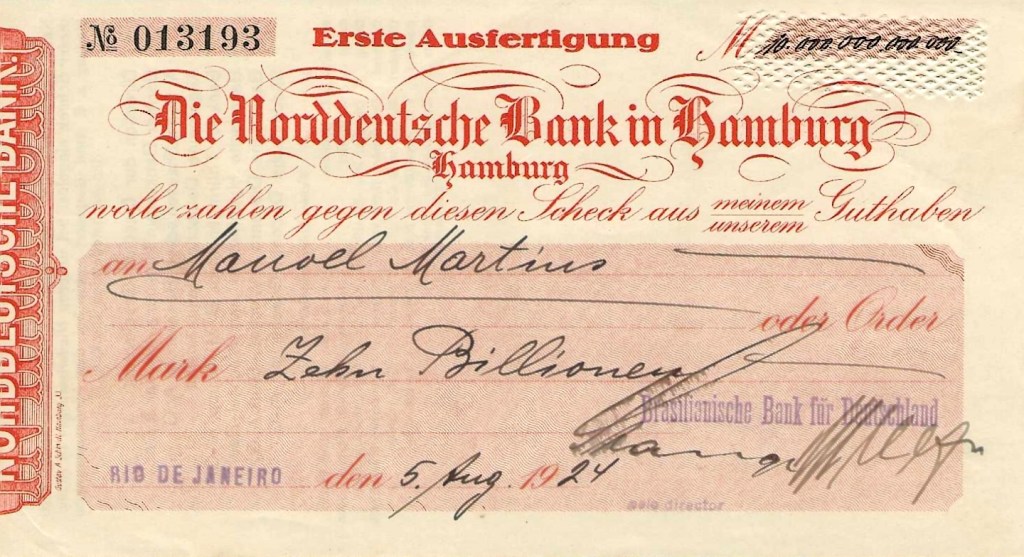
Foreign exchange departments at banks outside Germany found their customers making novelty checks in order to become paper millionaires and billionaires. But the banks did not always get it right. The German numbering system differs from that used in the United States. While US numbers go from million to billion to trillion, the German system goes from million to milliarden to billion. The checks shown above for 1,000,000,000 and 15,000,000,000,000 marks show this confusion in the numbering systems.

Check drawn on a German bank written by a German bank Brazilian Bank for Germany on another German bank (Norddeutsche Bank in Hamburg) for 10 billion marks. The written numerals (10,000,000,000,000) and the numerical words (10 billion) match on this check.

Don’t Take Any Wooden Nickels

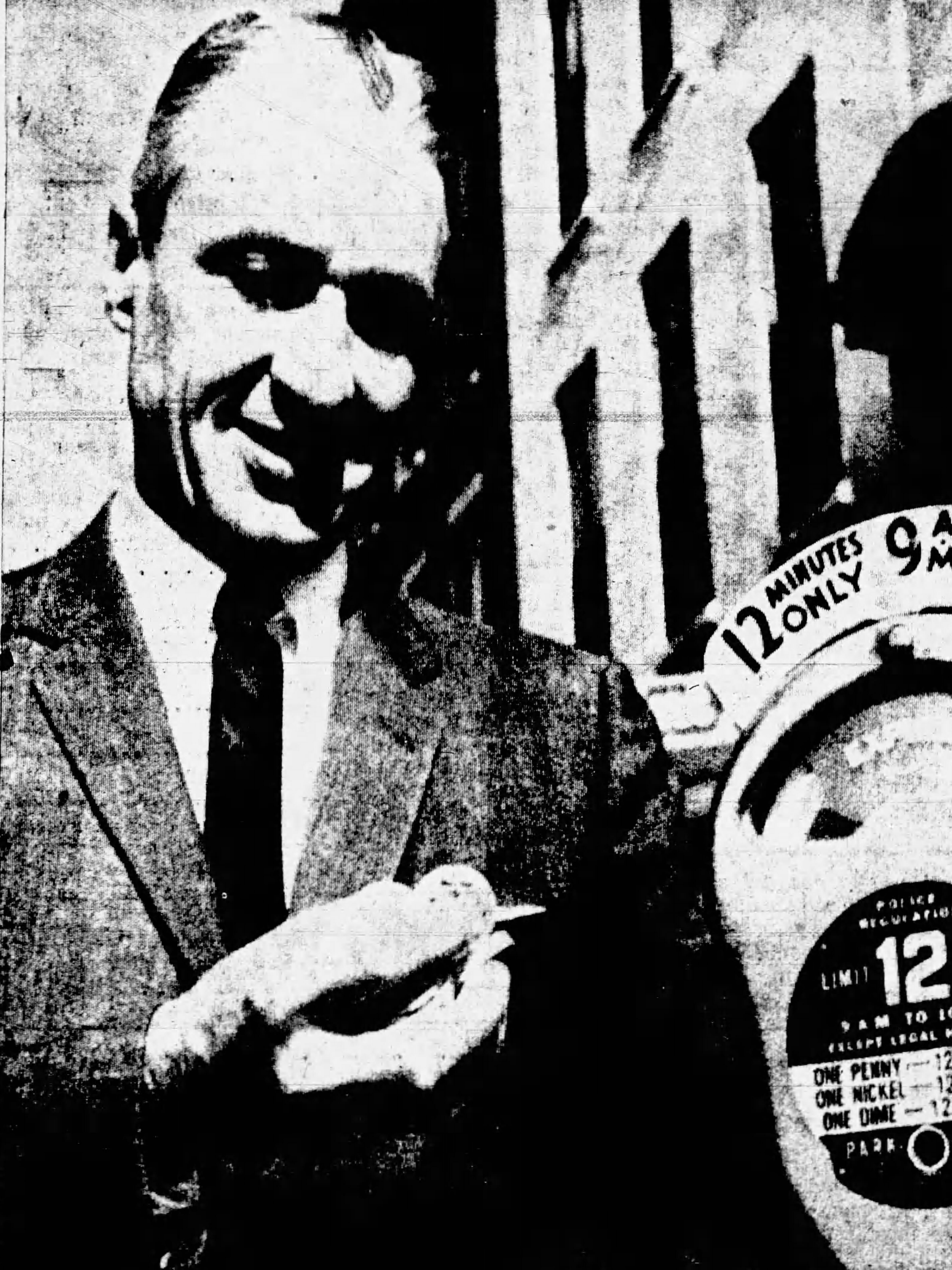
Edward Adam, president of the First National Bank of Monroe, Wisconsin attempting to plug a meter with one of the bank’s wooden nickels. (UPI Photo).

In May 1964, Edward Adam, the president of the First National Bank of Monroe, Wisconsin was facing a problem. The bank, like banks in many parts of the country, was dealing with a coin shortage. Rising silver prices had led speculators to hoard US coins and the post-war vending machine boom strained the supply of circulating coinage. Adam and the bank decided to deal with the problem themselves by circulating wooden nickels.

Wooden nickels like this balsam flat from Manitowoc County, Wisconsin were popular advertising media.

Wooden nickels were a popular souvenir in the United States from the 1930-50s. The most popular type were thin, rectangular balsam strips printed on both sides usually to commemorate an event or significant anniversary like a municipal centennial. In the early 1960s, wooden nickels in the form of round tokens began to be used by businesses as a cheap advertising medium. It seemed like a reasonable solution to the bank president.

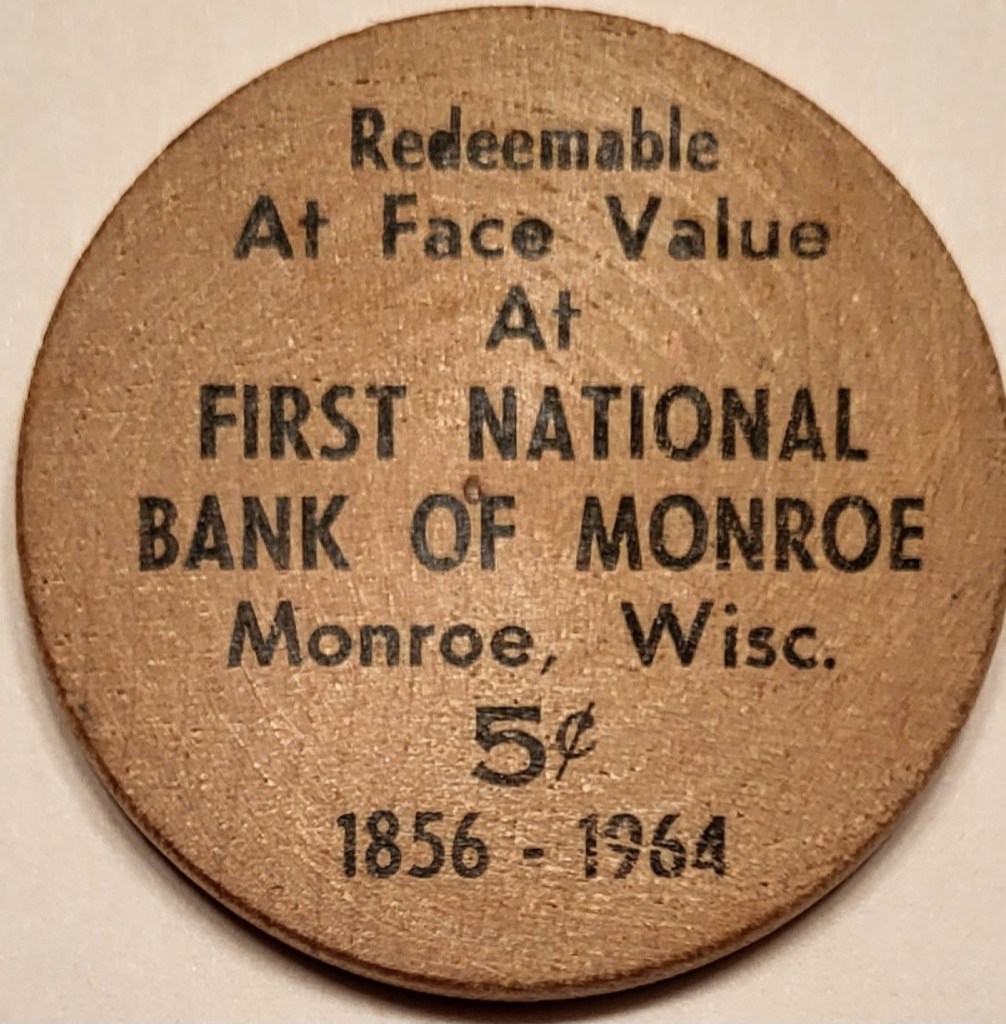
The obverse of the Monroe, Wisconsin wooden nickel from 1964.

The bank in Monroe placed an order for 20,000 wooden nickels with an advertising jobber in Minnesota. They began circulating on May 20, 1964. The bank had pledged to redeem all the wooden nickels in circulation. They were an immediate success and a boon to the local economy.

The reverse of the Monroe, Wisconsin wooden nickel of 1964. The redemption language incurred the wrath of the US Treasury.

They were so successful that, when the United States Secret Service arrived at the bank a week later, only 450 remained on hand. What seemed like a novel solution to Adam was a federal crime. The Treasury Department determined that the bank was issuing its own currency and had to put an immediate end to this threat to the integrity of the US money supply.

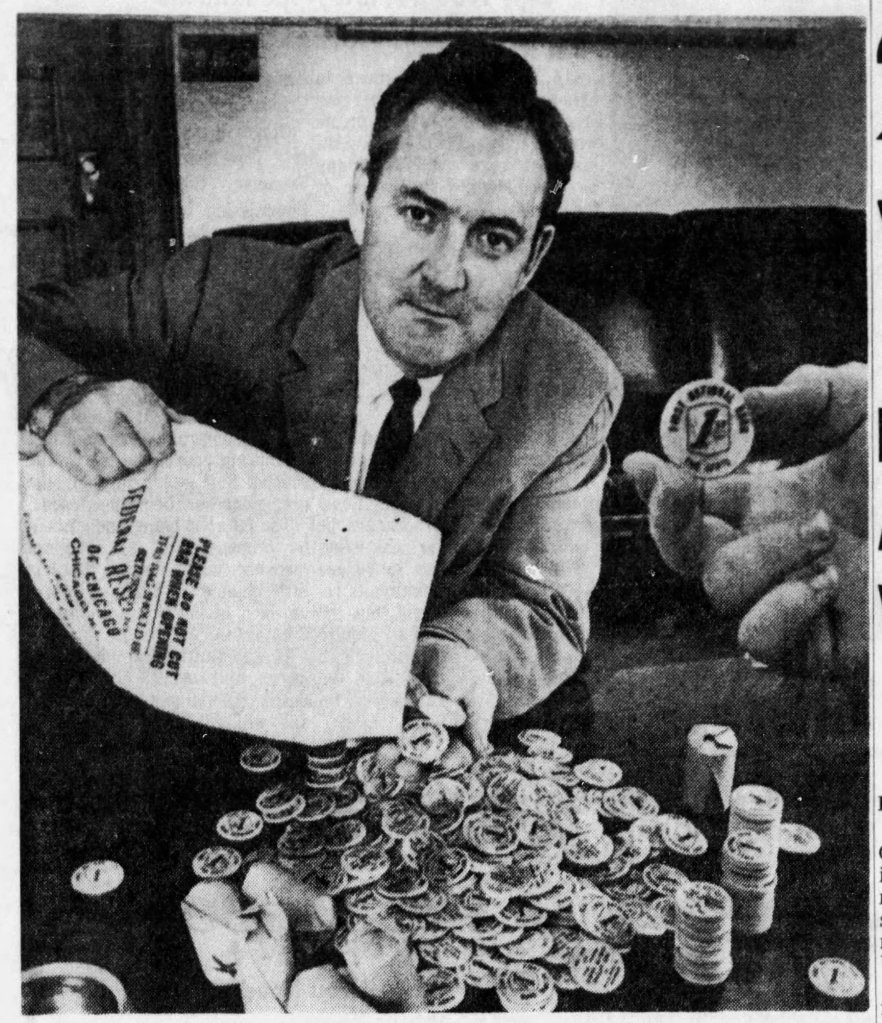
US Attorney Nathan Heffernan with the confiscated wooden nickels of the First National Bank of Monroe, Wisconsin. (Wisconsin State Journal).

The Secret Service, through the United States Attorney in Madison, demanded the bank cease circulating the tokens and recall all those that had been issued. The bank did what it could and on June 3, 1964 turned over what remaining stock it had to the US Attorney.

Newspaper accounts of the debacle were picked up by the wire services and collectors came calling. The First National Bank of Monroe and local merchants received inquiries from collectors around the country looking for examples of the contraband timber. Prices settled in at $5.00 per token. The bank, of course, could not comply with collector requests but the good citizens of Monroe were not above a little profiteering.