A few months ago I wrote about transportation numismatics of Door County. Somehow I managed to forget to include one of the largest pieces in the collection.
The document shown above is a specimen of a $1,000.00 bond issued by the Sturgeon Bay and Lake Michigan Ship Canal and Harbor Company. The bonds were issued to finance the construction of the canal connecting these two bodies of water across the Door County peninsula in 1873. The original piece is too large to fit on a standard scanner. The lower half not shown in the scan consists of interest coupons. This is either an unissued remainder or a printer’s specimen.
I obtained the bond from Chet Krause in about 2012. Chet thought enough of it to picture it in his book on Wisconsin Obsolete Paper Money and Scrip even though it is neither. Chet knew I lived in Door County (he referred to me affectionately as that damn lawyer in Sturgeon Bay) and offered it to me when he was dispossessing himself of his collection in the years before he died. I am proud to be its current caretaker.
A not entirely to scale rendition of Lake Michigan, Green Bay and the Sturgeon Bay canal from the Chicago publication the Land Owner marking the opening of the canal. (The Newberry Digital Collection).
Construction on the canal began in 1872 across a 1.3 mile strip of land that separated Sturgeon Bay and Lake Michigan. It was completed in 1881. The canal shortened the trip between Green Bay and the Lake Michigan ports by 150 miles. It also eliminated crossing Death’s Door, the treacherous channel between the northern end of the Door peninsula and Washington Island.
The canal had a tremendous effect on the development of Sturgeon Bay and Door County in the late 19th Century. The ships passing through provided a vital link between the county and the rest of the world as the roads to the county were primitive and there was no rail connection yet. It resulted in Sturgeon Bay becoming a center of shipbuilding.
NOAA map of Sturgeon Bay and the canal. The yellow line is the canal and the red line is the dredged ship channel. The inset is the city of Sturgeon Bay
Great Lakes shipping continues to pass through the canal but it has a greater significance for smaller boats than the lake freighters. The canal makes Sturgeon Bay the center of a large and varied sport fishing industry allowing for salmon fishing on the big lake, smallmouth bass on Sturgeon Bay and perch and walleye on Green Bay all from a central location.
Notgeld from 1921 from Oberammergau depicting death ravaging the area in the 1630s
It is Easter weekend and the only notes that I could find related to this Christian holiday are notgeld from the German town of Oberammergau highlighting the decennial Passion Play performed there.
The Oberammergau Passion Play has its origins in an outbreak of bubonic plague in 1633. The villagers promised God that they would perform a play depicting the life, death and resurrection of Christ every 10 years if the community was spared. Over the next year deaths in the village declined dramatically. The villagers kept their promise and performed the play for the first time in 1634. It has been performed ever since in years ending in zero (except for 1940 when WWII got in the way).
The play includes dramatic renditions of Old and New Testament stories. It is performed for five months from May through October. The production lasts several hours. The performers are all residents of the village.
The central vignette on this 50 pfennig notgeld from Oberammergau depicts a scene from the 1634 production of the Passion. Two of the authors of the original Passion, Othmar Weiss and J. A. Daisenberger flank the image. The back is a depiction of Oberammergau in 1634.
The United States took possession of the Philippines from Spain after the Spanish-American War. Coinage and paper money for the Philippines were made by the United States until independence in 1946.
After the Japanese invasion in 1941, the gold and silver in the Philippine treasury was secreted out of the country on board the submarine USS Trout. Guerrilla forces loyal to the United States administration harassed the Japanese occupiers. Feeding and equipping the guerrilla armies cost money.
USS Narwahl, one of the submarines that supplied the guerrilla armies in the Philippines.
Arms, equipment, food and other provisions were brought to the Philippines by submarine during the war. These supply missions also brought with them money. Two different types of money were brought in — counterfeit Japanese military pesos and pre-war Commonwealth of the Philippines notes. The counterfeit Japanese notes will be discussed in a subsequent post.
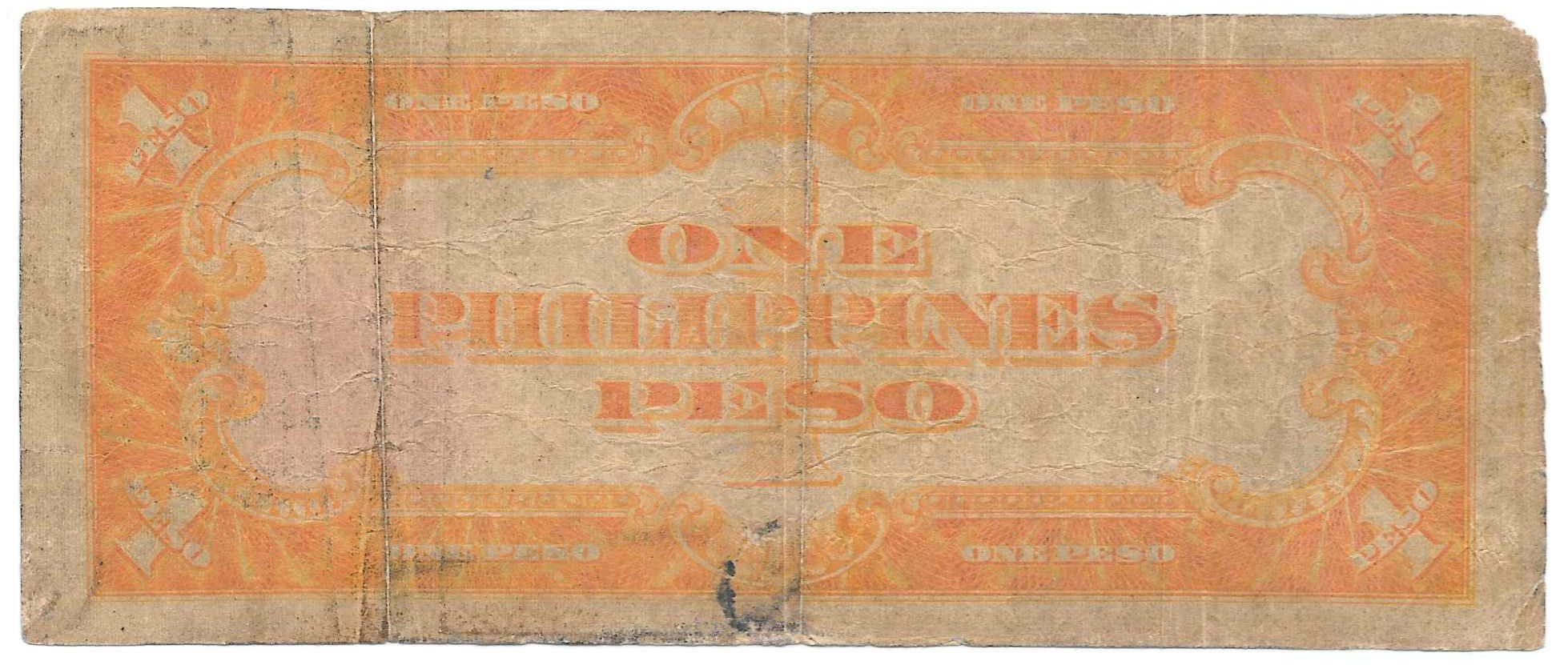
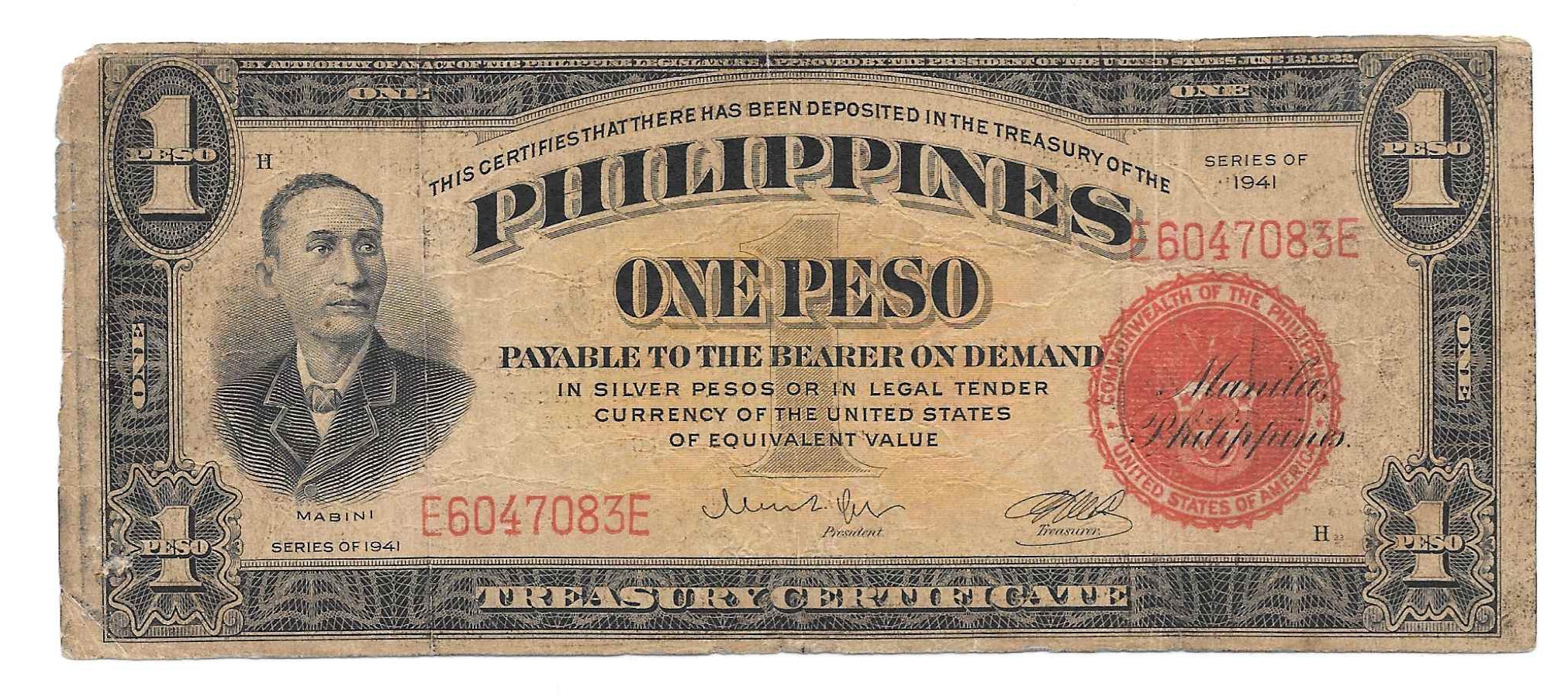
The War Department asked the Bureau of Engraving and Printing to print additional pre-war Philippine paper money. The last series of paper money issued in the Philippines had been put into circulation in 1941. The BEP printed a short run of these notes for the War Department in denominations of 1, 5 and 10 pesos.
The War Department believed that the Japanese would be suspicious of anyone who was found in possession of brand new currency notes so the first group of notes ordered by the War Department was artificially aged by the Bureau of Standards. The notes were tumbled in metal drums containing dirt, coffee grounds and other contaminants to soil the notes.
The printing and artificial aging of the notes was a clandestine operation. The existence of this special series of notes was uncovered by author and researcher Neil Shafer in the 1960s when he stumbled upon correspondence and records relating to their printing in the National Archives. Included in this documentation were the serial numbers of the notes that were artificially aged. The serial numbers for each denomination are as follows:
As you can see, the number of notes printed was small — 300,000 1 peso notes, 20,000 5 peso notes and 60,000 10 peso notes. All denominations are scarce with the 10 peso being rare. The artificial aging can fool dealers and collectors alike who may pass on the notes because of their low grade.
In 1948 the United Nations Educational, Scientific and Cultural Organization (UNESCO) established a coupon system to aid in the acquisition of educational, scientific and cultural books and other media especially in less developed countries.
Coupons were originally issued in values of US$.25, 1.00, 3.00 and 10.00. The $.25 coupon was dropped many years ago and a $30.00 and $1,000.00 coupon have been added. Coupons can be purchased from UNESCO representatives in any country using local currency at the exchange rate for US dollars. A surcharge not exceeding 5% may be added by the local UNESCO office.
The coupons can be used to purchase qualifying materials from suppliers who are willing to accept the coupons. Qualifying materials originally only included books but this has been expanded to include maps, sheet music, computer hardware and software, textbooks and school supplies, as well as scientific supplies such as laboratory equipment, testing devices and tools. The UNESCO offices maintain lists of suppliers who are known to accept the coupons.
UNESCO coupons are bearer instruments but can only be redeemed by merchants who who deal in eligible products. They are valid for four years from the date of issue. Coupons that have passed their expiration date can be exchanged for new coupons at UNESCO offices.
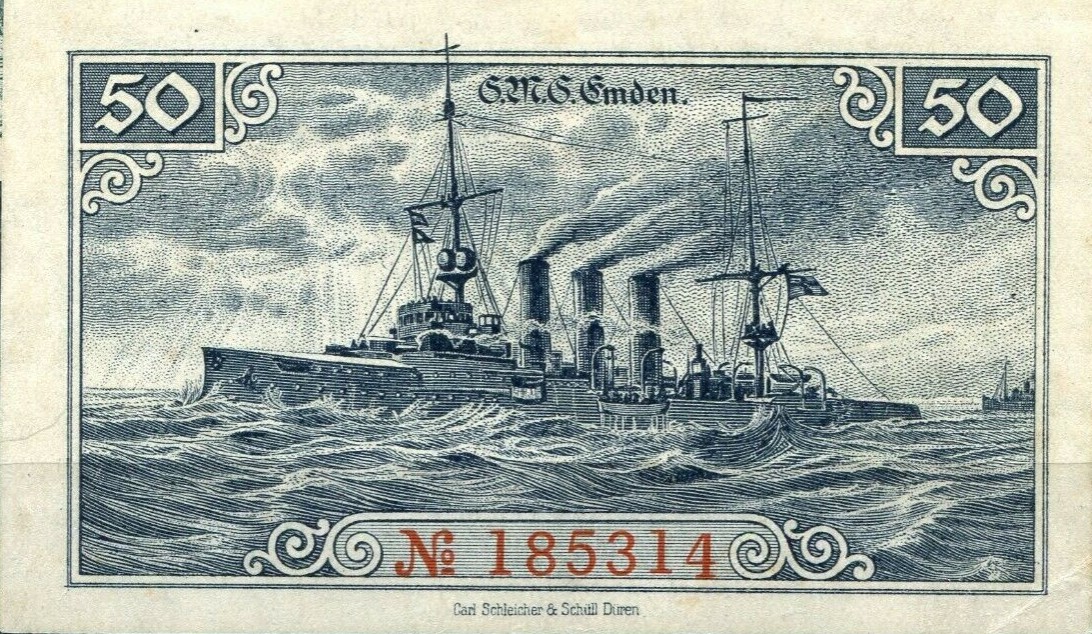
Fifty pfennig notgeld depicting the SMS Emden issued by her namesake city in 1918.
The SMS Emden was a cruiser in the German Imperial Navy. Her keel was laid in 1906 and the ship launched in 1908. After shakedown, she was commissioned in 1909. Her first and only posting was to the East Asia Squadron whose home port was the German concession in China at Tsingtao. She arrived on station in July 1910 meeting the rest of the fleet in German Samoa.
SMS Emden in the port of Tsingtao in early 1914.
For the next four years, Emden took part in operations in the Pacific protecting German interests. She participated in Yangtze patrols and helped suppress rebellion in the Carolines. In August 1913 she thwarted an attack on her by Chinese revolutionaries while at Nanjing.
Korvettenkapitan Karl von Muller.
In May 1913, Lt. Commander Karl von Muller took over command of the Emden. He had spent his early career as a signal officer on ironclads and spent time in German East Africa on the SMS Schwalbe. He served on the staff of Admiral Prince Heinrich of Prussia and then with the Imperial Navy Office in Berlin. In that service he caught the attention of Admiral von Tirpitz who rewarded him with command of the Emden.
With the winds of war blowing throughout the summer of 1914, von Muller took Emden out to see at the end of July. Germany declared war on Russia on August 2 and Emden recorded her first victory by capturing a Russian vessel that had yet to hear the news that war had been declared.
Admiral von Spee determined that the East Asia Squadron was to return to Germany to assist in the European conflict by sailing around South America. (Most of it would be destroyed at the Battle of the Falklands). Von Muller suggested that one cruiser remain to keep a threat in the area. Emden was the fastest of the German ships so she headed for the Indian Ocean while the remainder of the fleet went southeast across the Pacific.
Emden’s route through the Indian Ocean.
Emden wreaked havoc in the eastern Indian Ocean as a commerce raider. Between August and November she sank 30 Allied vessels and attacked Madras and Penang. Shipping traffic dropped by over 60% in the region as a result. She was partly aided by deception and the slow pace of communications. The Germans installed a dummy smoke stack to disguise Emden as a British vessel and when she put into Diego Garcia for maintenance the British garrison had still not received word that the war had begun over a month earlier!
On November 9, von Muller turned the ship’s attention to the wireless station on Cocos Island. Arriving early in the morning and seeing no Allied vessels in the region, von Muller put a landing party on shore to take care of the transmitter. Emden was spotted and when she failed to identify herself the wireless station broadcast that an unidentified vessel was approaching.
HMAS Sydney
Answering the call was HMAS Sydney. von Muller believed Sydney was 200 miles furtjer away than she was and thought there was enough time for the landing party to complete its mission. At 0900 lookouts on Emden spotted smoke in the distance and identified it as a warship. Knowing that he was probably outgunned and definitely outnumbered, von Muller knew it was time to escape. There was no time to retrieve the shore party.
Sydney closed to 9,500 yards and began to shadow Emden’s moves. von Muller knew his only chance was to come within Sydney’s range and fire all he could at the Australian vessel and hope to inflict as much damage as possible before Sydney could find her range. The German volleys had little effect. von Muller tried four times to approach to within torpedo distance but Sydney backed away every time.
The wreck of the SMS Emden off Keeling and Cocos Islands.
It did not take long for Sydney’s guns to zero in on Emden and by 1045 Emden was no longer able to return fire. von Muller ran the remains of his ship onto the reef off Cocos Island to prevent its sinking and to save the crew. Emden’s weapons were disabled and the code books burned. The German casualties were heavy — 134 dead, 69 wounded. Most of the survivors were taken prisoner.
German shore party departing Direction Island in the Keeling and Cocos Group. The three masted schooner in the background is the Ayesha.
The landing party observed the naval battle and knew there would be no rescue. They commandeered the three masted schooner Ayesha and headed for the Dutch East Indies (the Netherlands was still neutral). The landing party eventually made its way to the Ottoman controlled Arabian Peninsula and back to Germany.
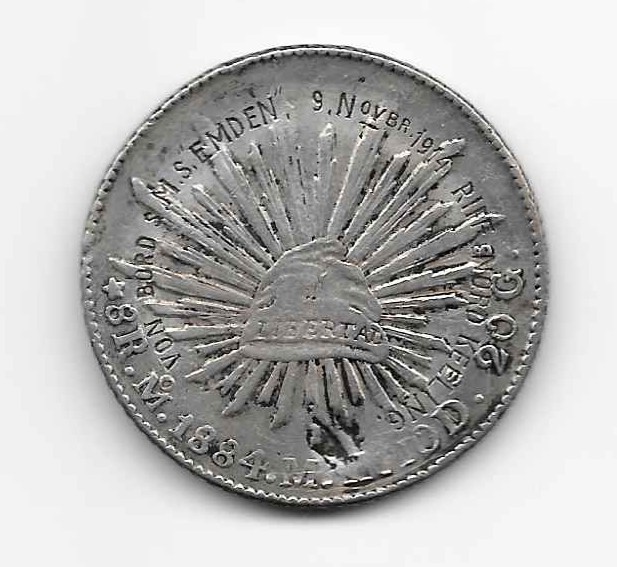
It would not be until November 11 before the Sydney and her crew could board the remains of the Emden. Although the weapons and code books were destroyed, the Australians did find one thing of use still on the ship. Emden’s payroll consisting of some 3,000 Mexican silver dollars were seized. The Australian Admiralty turned some of these into souvenirs by affixing a commemorative broach and presented them to senior officials.
Mexican one peso coin from 1884 that survived the sinking of the SMS Emden off the Keeling and Cocos Islands in 1914.
At least one German also made a souvenir out of a Mexican Peso inscribing the piece shown above with the legend “Von Bord S.M.S. Emden 9 Novbr 1914 Riff Nord Keeling”.
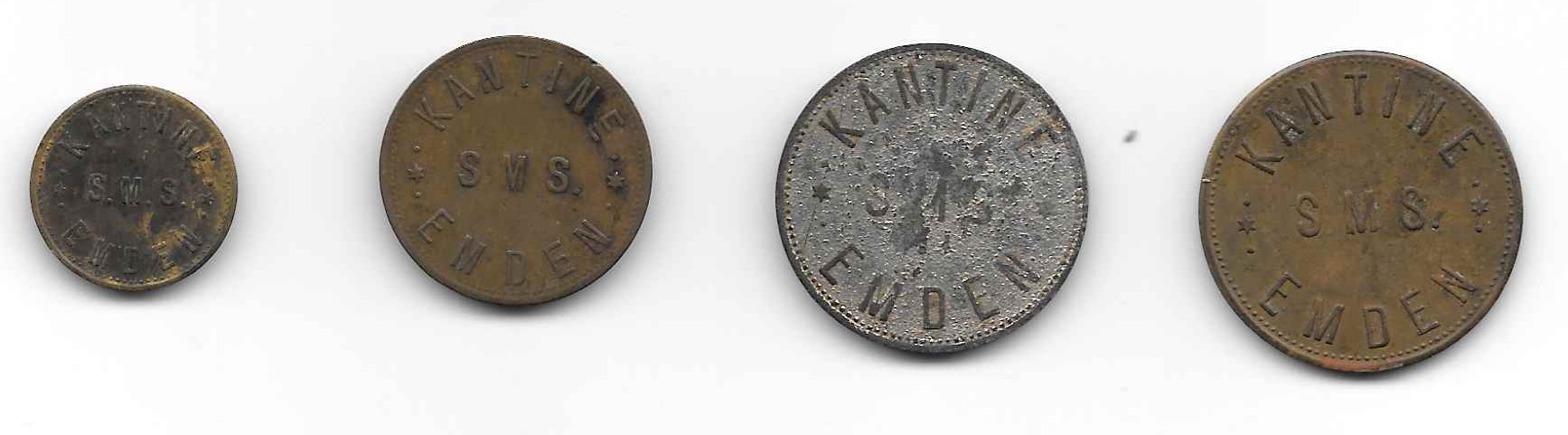
Canteen tokens used on SMS Emden. The denominations are 10 pfennig, 50 pfennig, 1 mark and 2 marks.
German naval vessels issued tokens for use in their canteens. The above set of tokens were from the SMS Emden. Most of the SMS Emden tokens in the collector’s market were looted from the ship by the crew of the HMAS Sydney.
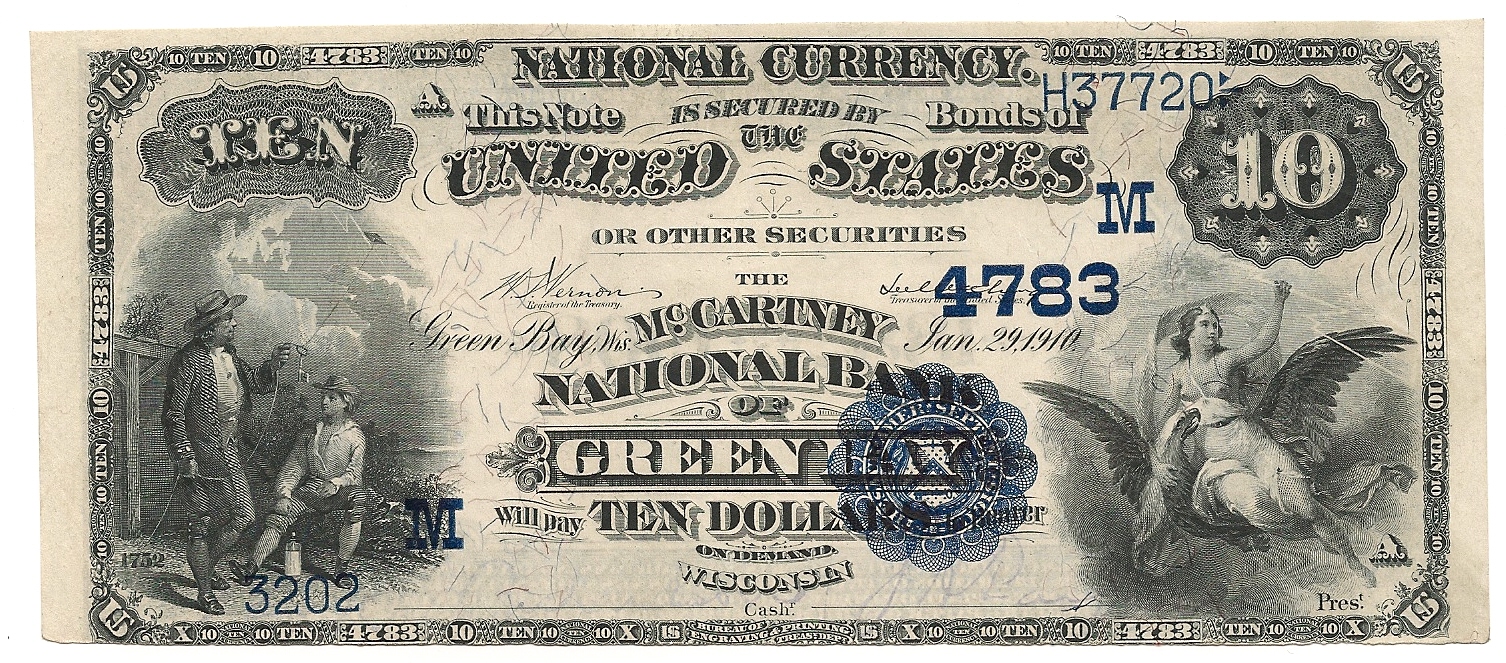
$10.00 Second Charter note from the McCartney National Bank of Green Bay, charter number 4783.
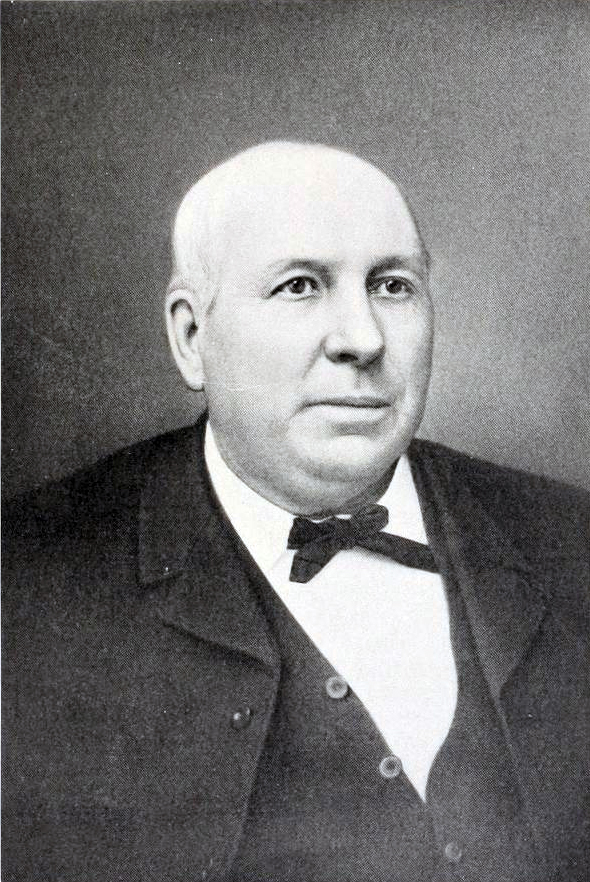
George A. Richardson began working as a messenger for the McCartney National Bank of Green Bay at the age of fourteen in 1891. He worked his way up the ladder to cashier and was made president of the bank in January 1931 succeeding his brother-in-law J.H. Tayler. On May 21, 1931, Richardson arrived at the bank in the morning and met briefly with Tayler, cashier T.G. Bailey and assistant cashier Bernard Olejniczak. He retrieved a pistol from the cashier’s cage, walked into the bathroom and shot himself — precipitating the beginning of the end of the bank.
David McCartney, founder of the McCartney Exchange Bank. (Picture from findagrave,conm).
Joseph H. Tayler, the first cashier and later president of the McCartney National Bank. (Picture from findagrave.com).
The McCartney Exchange Bank was founded as a state bank in 1882 by David McCartney in Fort Howard, Wisconsin (presently the west side of Green Bay). It was incorporated as a national bank in 1892 as the McCartney National Bank of Fort Howard receiving charter number 4783. Three years later when the borough of Fort Howard was married to the city of Green Bay the bank changed its name. McCartney was lured to Wisconsin from Ohio by the lumber industry and operated two saw mills near Green Bay before investing in pine lands in Georgia.
$10.00 Third Charter Date Back note from the McCartney National Bank from 1912. Note the stamped signatures of G.A. Richardson as Cashier and J. H. Tayler as president.
Tayler succeeded McCartney as the bank president in 1892. The bank prospered in the early part of the twentieth century under his direction. It was key to financing much of the development on the near west side of the Fox River. Among the banks largest customers were the Larsen Company canning operation and the Green Bay Sugar Company. Tayler served on the board of directors of these two companies as well as two state banks located in New Franken and Wrightstown, Wisconsin. This incestuous business and banking relationship would be a contributing factor in the bank’s demise.
$10.00 1929 Type 1 note from the McCartney National Bank.
The Fox River Valley area of Wisconsin weathered the Great Depression better than most parts of the country. The paper and tissue mills that lined the river remained viable although production decreased. The same could not be said for the local agricultural industries. Falling farm prices in the mid-to-late 1920s were caused by an overabundance of crops. The stock market crash of 1929 and the ensuing economic depression reduced the demand for agricultural products.
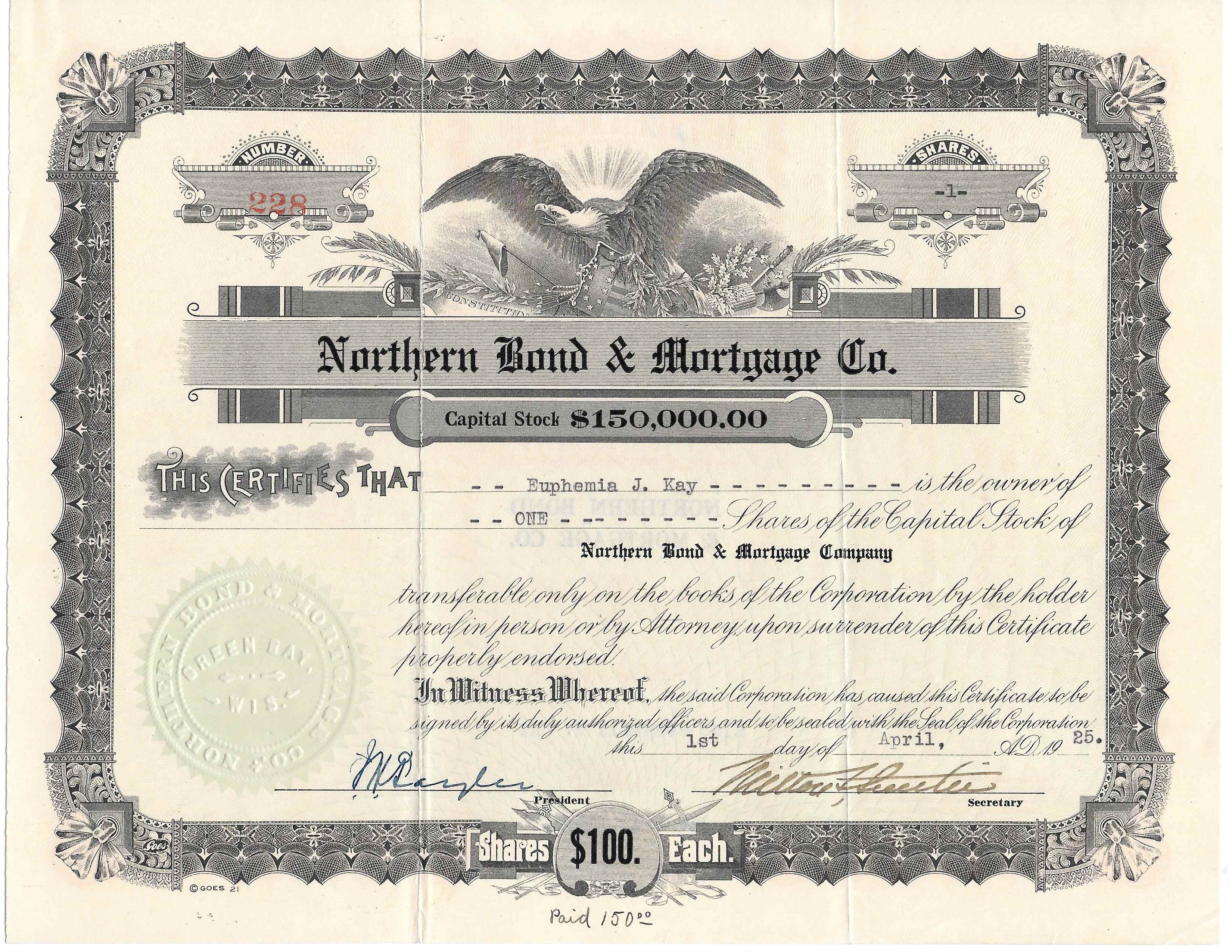
Stock certificate for Northern Bond & Mortgage, one of J. H. Tayler’s operations.
Tayler and Richardson were heavily invested in agricultural businesses in Northeast Wisconsin using their positions with the McCartney National Bank to finance the ventures. As the agricultural economy ground to a slow crawl, their house of cards began to unravel. Tayler and Richardson had borrowed heavily from the bank.
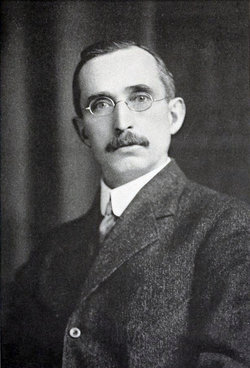
George A. Richardson, the final president of the McCartney National Bank of Green Bay. (Picture from the Green Bay Press-Gazette).
As news of Richardson’s suicide began to spread, panic descended on the financial institutions in Green Bay. By the end of the day $25,000.00 in deposits had been withdrawn from the bank. At a special shareholders meeting held that evening it was decided not to open the next day. In order to try to quell the fear in the community, J. H. Tayler announced that Richardson’s books had been examined and everything was found to be in order. Tayler’s announcement regarding the state of the accounts was technically correct, but he failed to disclose that the books only balanced because of notes owed to the bank by he and Richardson and other investors.
An uneasy calm settled over Green Bay for the next week. The operation of the McCartney National Bank was placed in the hands of a receiver. The crisis flared back up on June 2, 1931 when the Brown County State Bank closed its doors for examination and it was revealed that that institution was heavily intertwined with the McCartney National Bank. Pandemonium ensued as worried depositors streamed into the other Green Bay banks that morning.
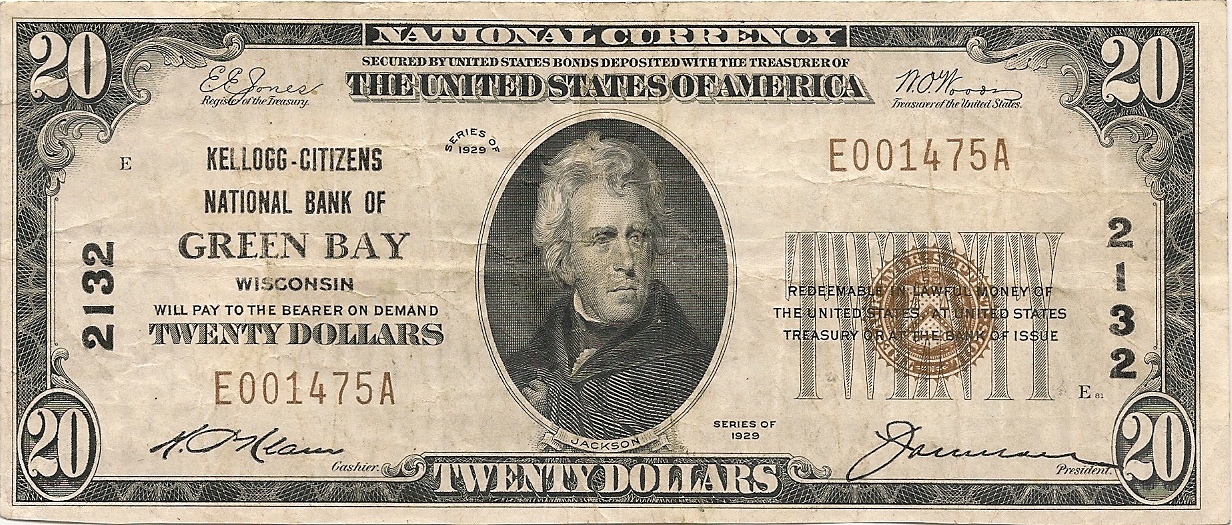
$20.00 1929 Type 1 note from the Kellogg-Citizens National Bank of Green Bay. The signature on the right is that of bank president John Rose who was instrumental in calming bank depositors during the 1931 panic in Green Bay.
John Rose, president of the Kellogg-Citizens National Bank, and other local leaders tried to soothe the mob. In a very public exhibition, Rose had prominent men enter the banks and ostentatiously make large deposits. The Kellogg-Citizens National Bank remained open after hours to allow depositors to make withdrawals – a sign that was intended to inspire confidence in the bank’s stability. A half million dollars in cash was trucked in from banks in Milwaukee and Chicago and when the Green Bay banks opened on June 3, it was displayed in large bundles on their counters. Sanity returned and the crisis was averted.
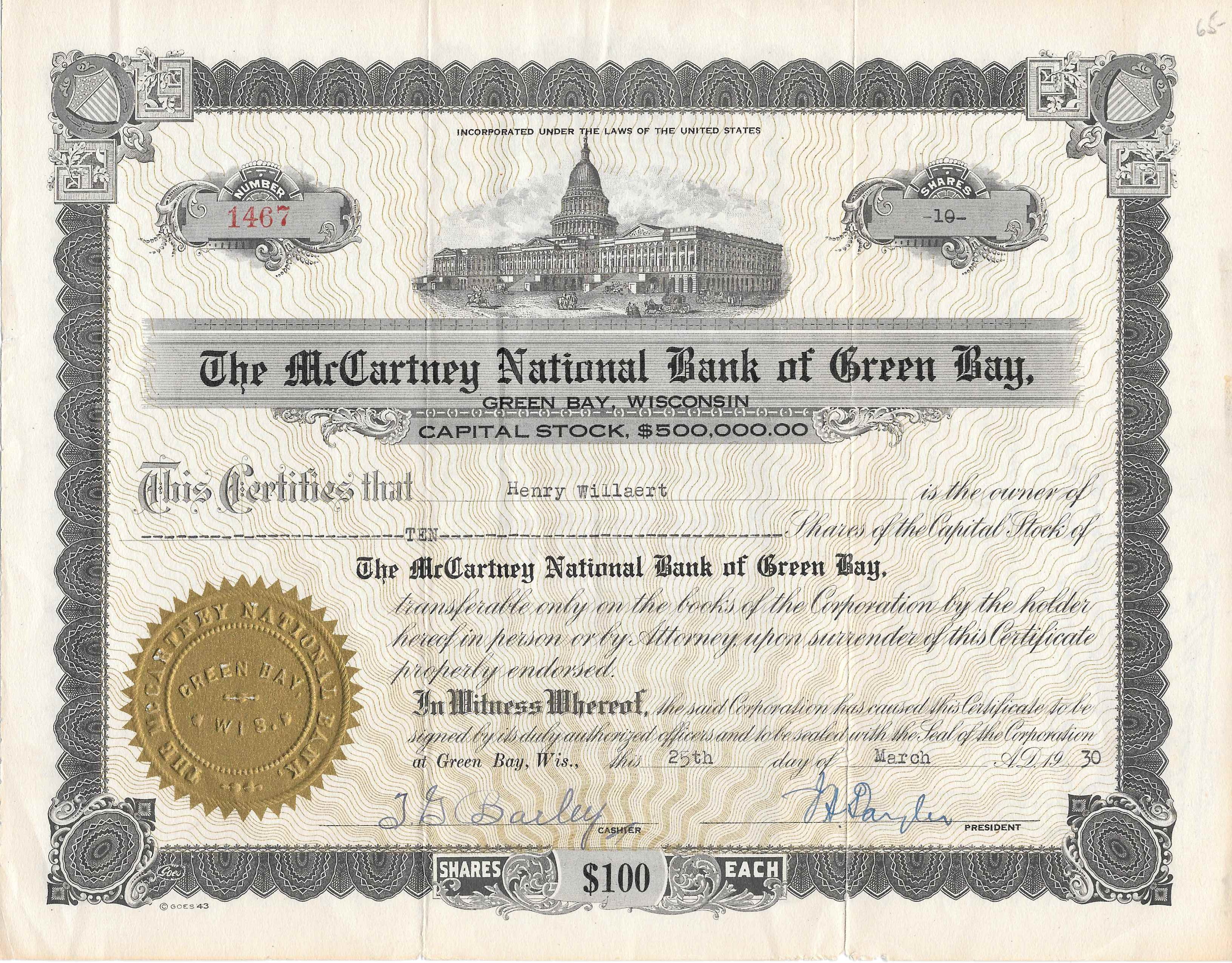
Stock certificate for ten shares of the McCartney National Bank of Green Bay.
But things would not go so well for the principals of the McCartney National Bank. C. C. Phelps, Tayler and Richardson’s brother-in-law and an investor in the bank and several of Tayler’s other businesses committed suicide as did Austin Larsen, president of the Larsen Canning Company, due to financial losses brought on by the collapse of the bank.
J. H. Tayler was arrested for embezzlement in September 1931 and filed bankruptcy in December of that year. He was essentially kiting checks among six different banks. He defended his actions as being acceptable banking practice. He was convicted in December 1932, the trial having been delayed due to poor health — despite this he managed to live another 28 years and passed away in 1959 at 100!
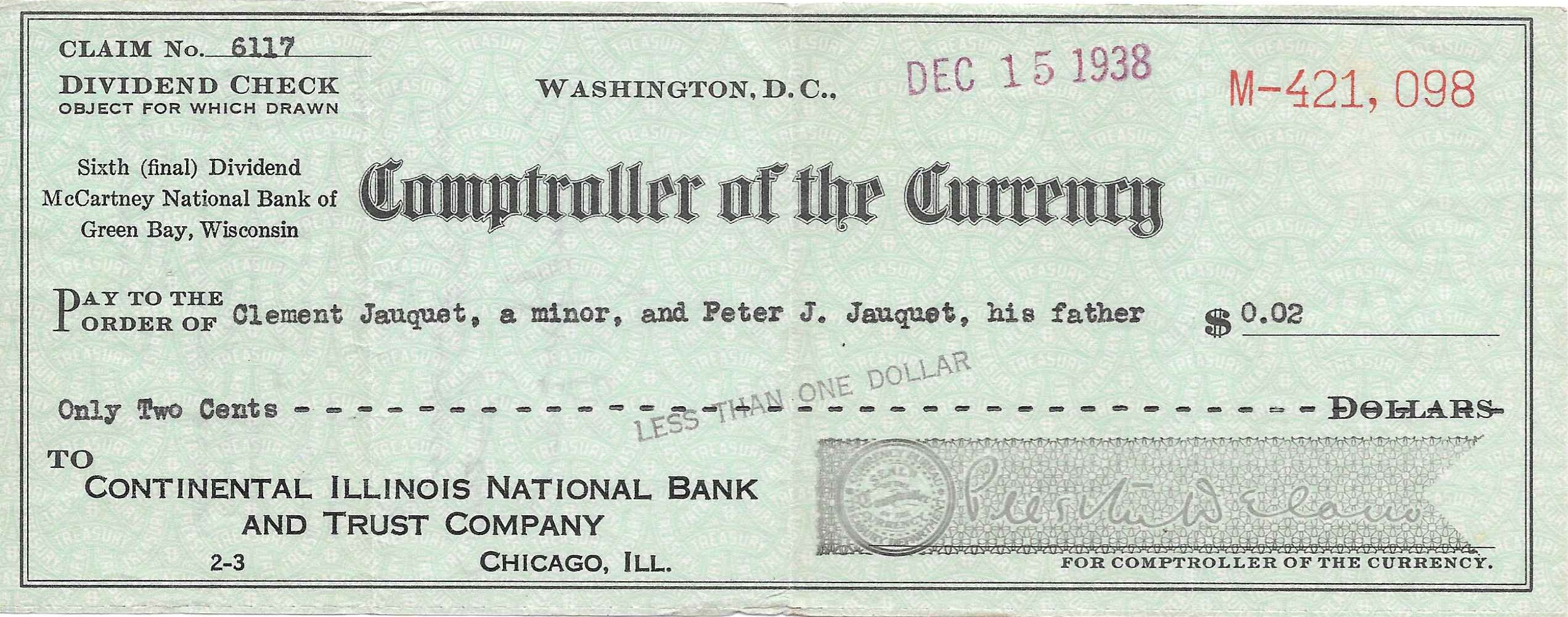
Check for $.02 representing the final liquidating distribution to a depositor of the McCartney National Bank of Green Bay
Things went better for the bank’s depositors. The receiver sold off the bank’s assets and called in a 100% assessment against the stockholders. It took several years but the depositors received most of their money back in a series of liquidating distributions. The Kellogg-Citizens National Bank took over the redemption of the still circulating National Bank Notes issued by the bank.
US Army map showing the locations of the major POW camps in June 1944
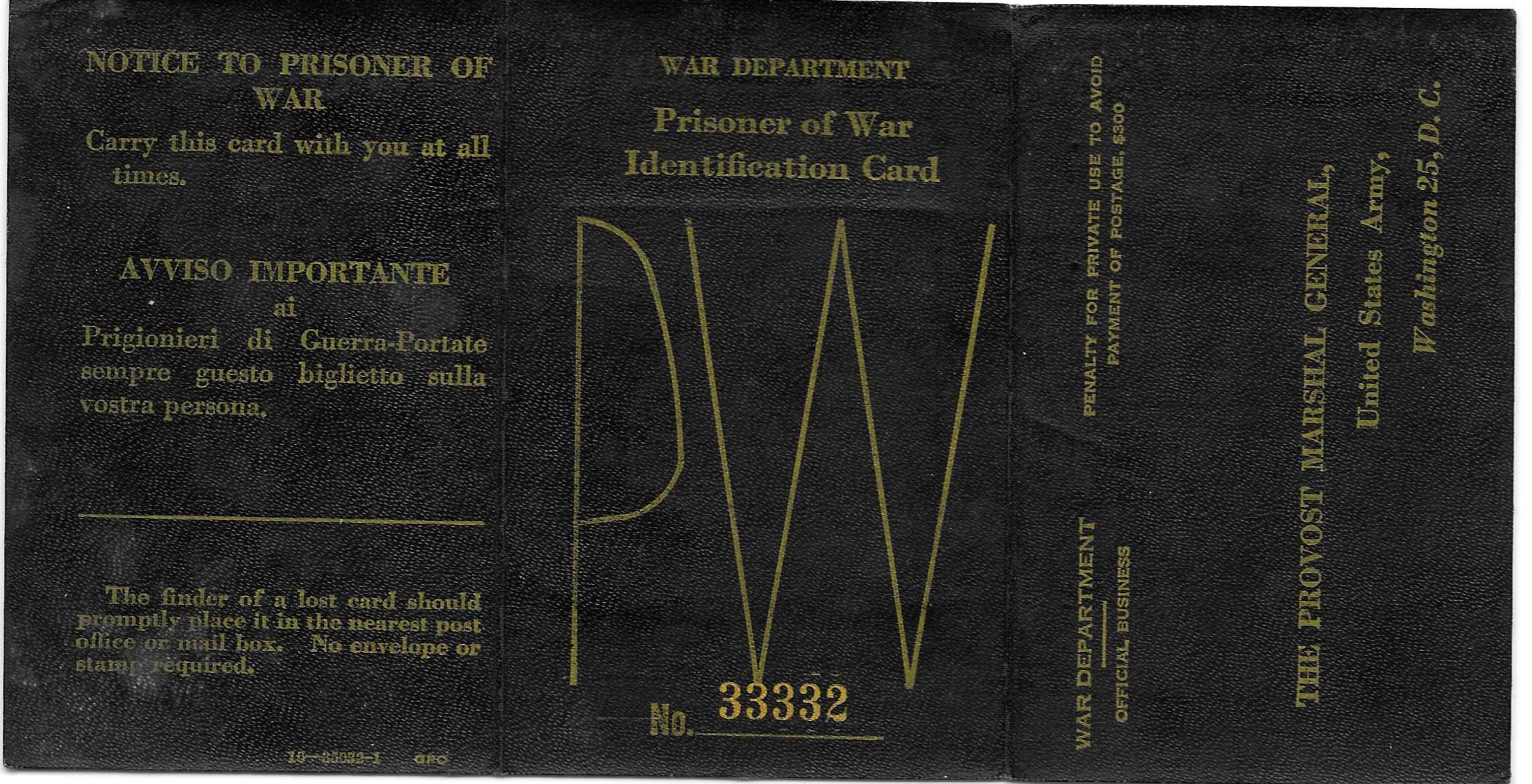
The United States took it first prisoner of war in WWII on December 7, 1941 when a midget sub piloted by Kazuo Sakamaki beached on the shores of Oahu. By the end of the war, over 425,000 POWs were housed in the US.
Back of a POW ID card for an Italian Prisoner of War in Charleston, SC.
The Geneva Conventions allowed for POWs to be put to work by their captors who were supposed to compensate the prisoners for their labor. The United States paid POWs who worked $.80 per day — the same amount earned by a private in the US Army. Prisoners worked in a variety of industries including agriculture, lumber and light manufacturing. The business owners paid the US government for the prisoners’ labor.
POW canteen chits issued at Billy Mitchell Field in Milwaukee. Prisoners worked at a number of local industries including battery and spark plug assembly and food packing plants.
Prisoners were not paid in cash. The amounts they earned were credited to them on account. In many camps there were canteens or exchanges where the prisoners could purchase personal care items, stationary, hobby supplies and even food. Chit booklets were distributed to facilitate purchases. The amount of the chit booklet was deducted from a prisoner’s account balance.
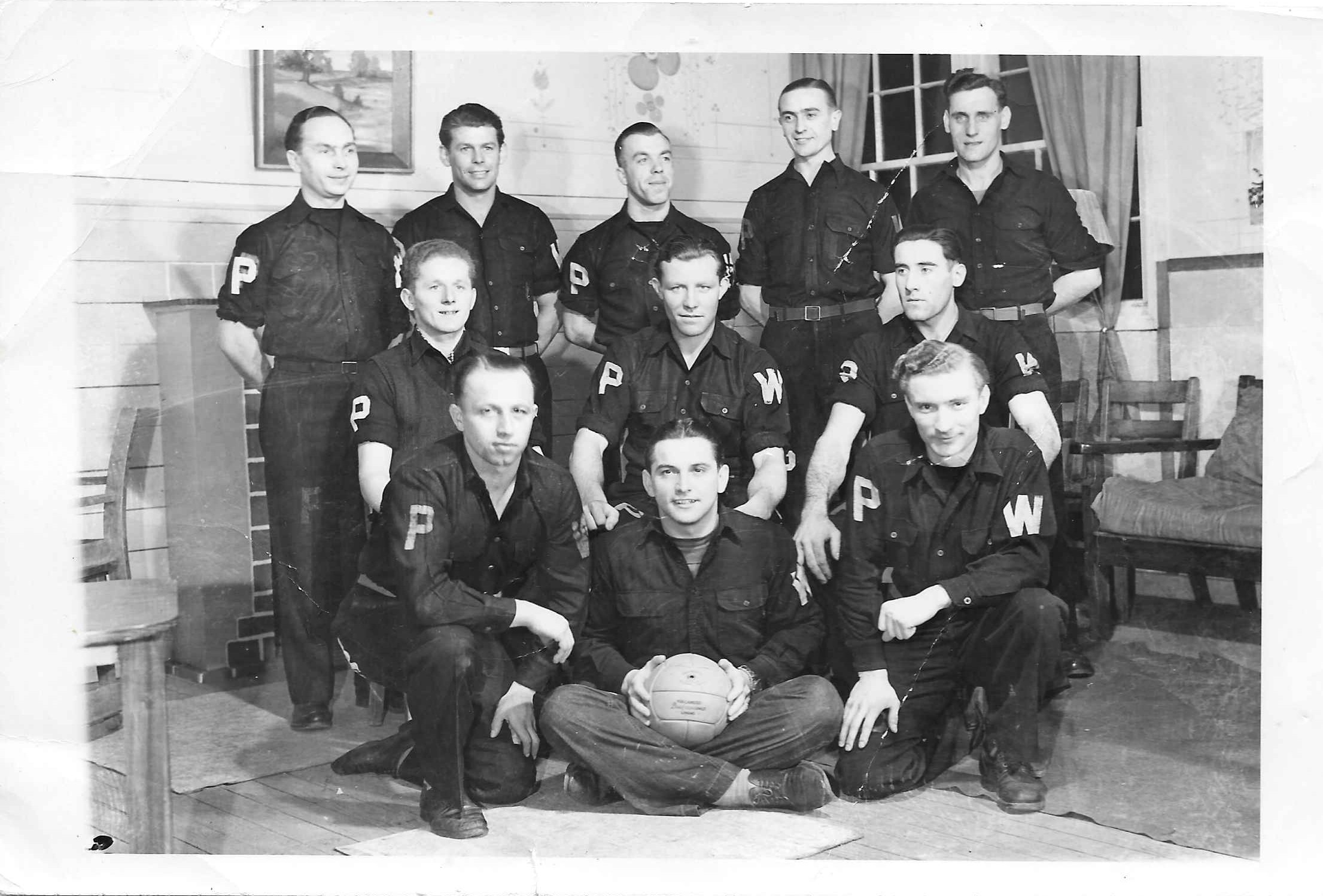
The starting eleven of the German POW soccer team from the camp at Roswell, NM.
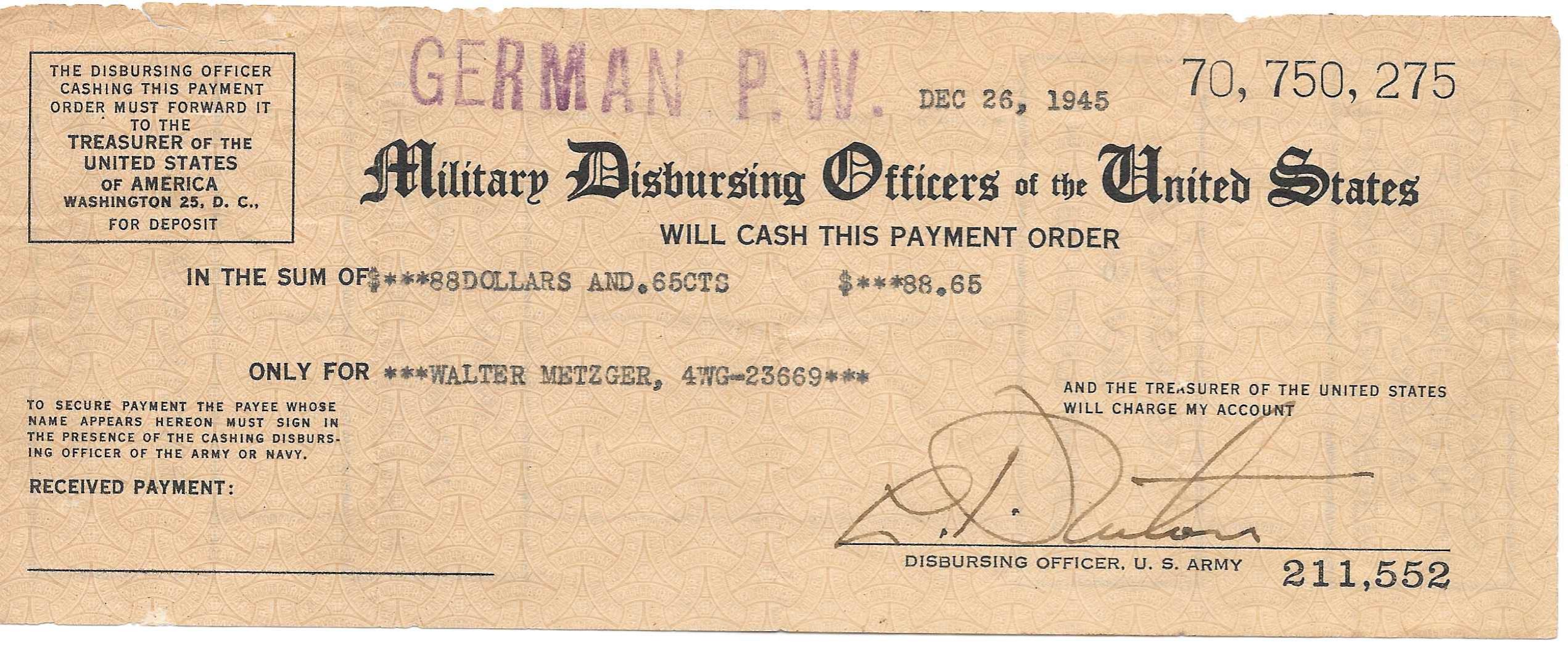
Prisoners could accumulate a significant amount of money during their captivity. Upon repatriation they received a check in the amount of the balance of their account. Although the checks were denominated in US dollars, they could only be cashed by US military disbursing officers overseas. This was done for two reasons.
Face of payment order for a German POW.
First, it prevented a prisoner from obtaining US dollars while still in the United States which could aid in escaping. Second, the military disbursing officers paid out Allied Military Currency denominated in the currency of a prisoner’s home country. AMC was issued by the Allies as occupation currency which resulted in the vanquished country paying the expenses of the occupation. Rather than being a liability of the United States, the balance in a POWs account became a liability of his home country.
For more information on the use of POW labor see History of Prisoner of War Labor by the United States Army 1776-1945 by LTC George P. Lewis. I also recommend the new book by my colleagues David Frank and David Seelye, The Complete Book of World War II USA POW and Internment Camp Chits.
In recognition of International Women’s Day I thought it appropriate to highlight a few items in the collection pertaining to women in the military.
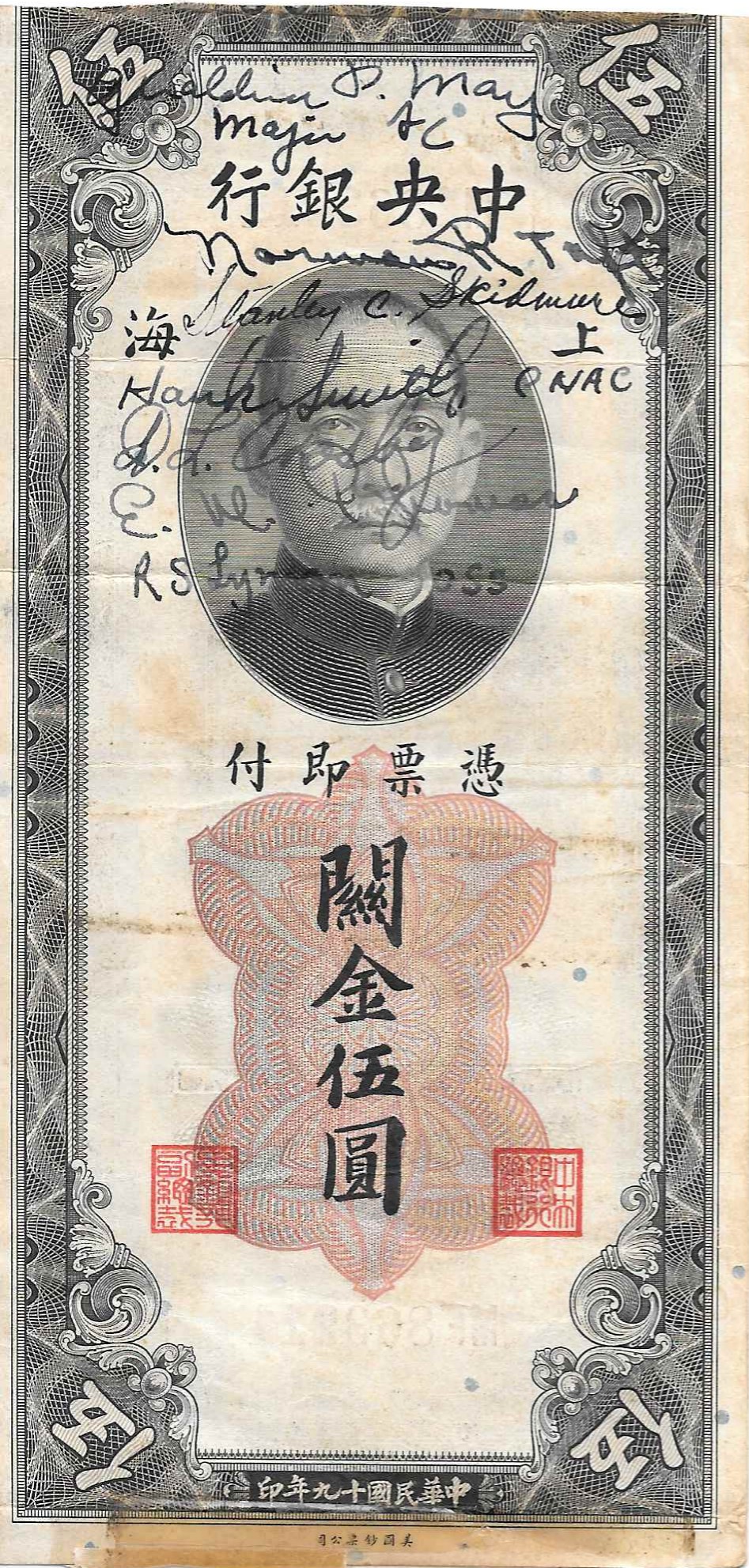
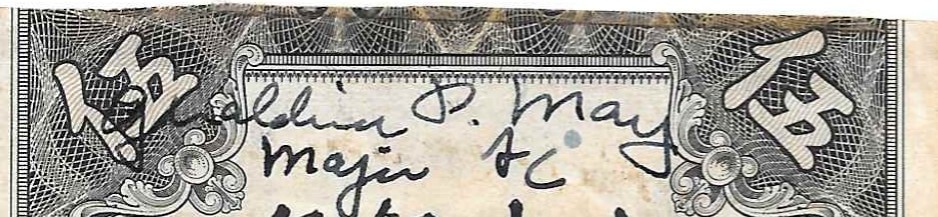
This first item is a short snorter on a Central Bank of China 10 customs gold units note. The first signature on the note is Geraldine P(ratt) May, Major, A(ir) C(orps).
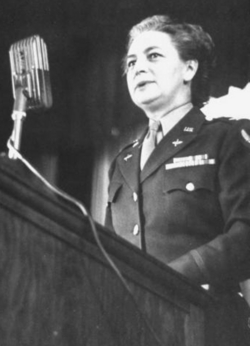
Colonel Geraldine Pratt May
Colonel May was born in 1895 in Albany, NY. She died in 1997 at the age of 102. Before the war she was a social worker and an executive with the Camp Fire Girls. She joined the Women’s Army Auxiliary Corps in July 1942. Upon completion of officer candidate school she was assigned to the Army Air Corps where she served as director of WACs in the Air Transport Command. After the war she was appointed Director of Women in the newly created United States Air Force. She was promoted to full colonel and was the first woman in the Air Force to hold that rank. She left active service in 1951.
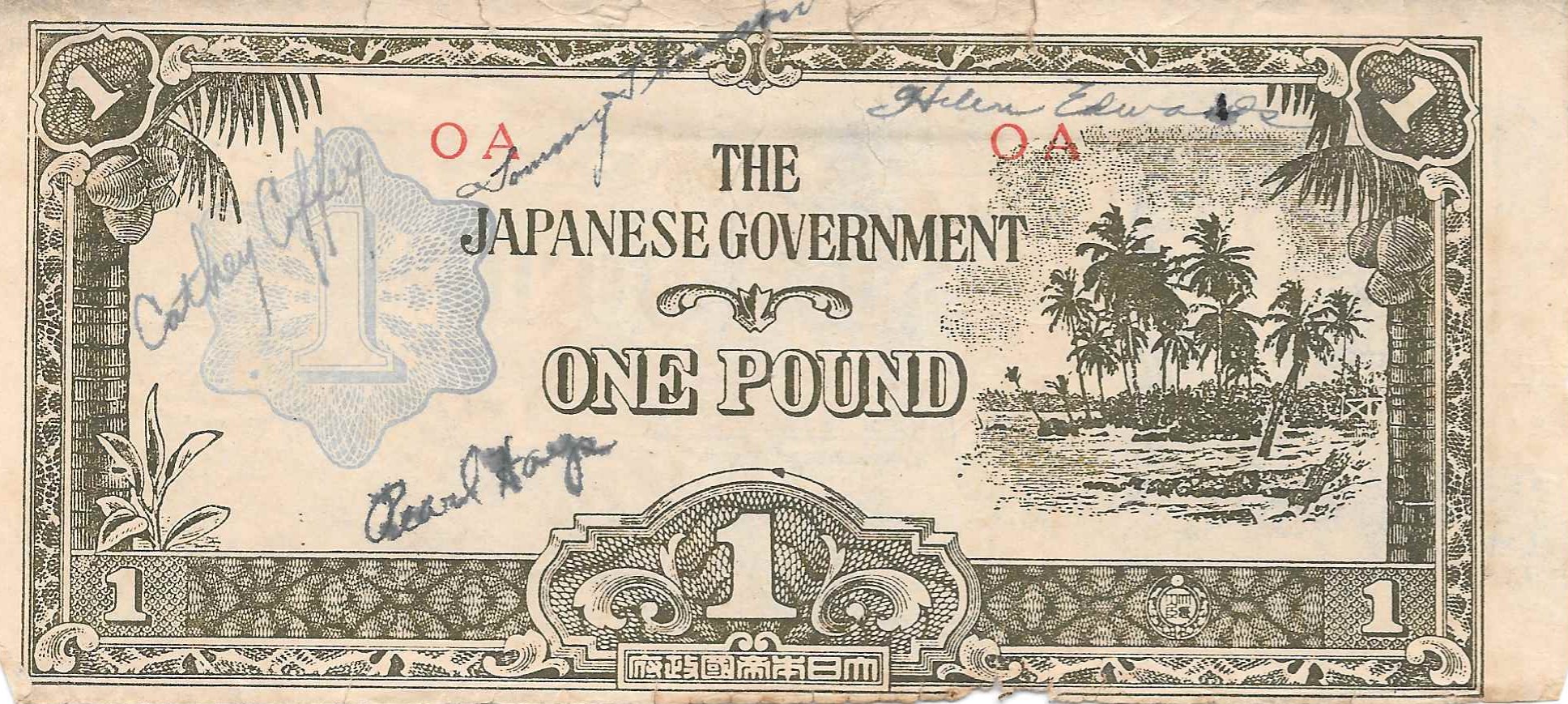
This next piece is also a short snorter with the signatures of four different women. The underlying note is an Australian made counterfeit of the one pound note issued by the Japanese for their occupation of Oceania. Three of the four signatures are positively identified.
Catherine F, (Coffey) Passmore
Tommy Thomson (Peterson)
Pearl L. Hays
Cathey (Catherine) Coffey was a WAC from Butte, Montana. She enlisted in May 1943. (Jean) Tommy Thomson was a nurse in Hastings, Nebraska when she joined the Army Nursing Corps in 1943. She served in Australia, New Guinea and the Philippines. Pearl Hays also joined the WACs in 1943. Her civilian job was a keypunch operator and the Army put her to work in cryptology in New Guinea and the Philippines. The identity of Helen Edwards, the remaining signature, cannot be verified. There were at least three different women with that name who served in the WACs.
This last piece is a $10.00 War Bond made payable to Mrs. Josephine Dannegger. The $10.00 bond was referred to as the Soldier’s Bond as they could only be purchased by US Army personnel.
Josephine Dannegger’s marker at Arlington National Cemetery
Ms. Dannegger immigrated to the United States from Germany with her husband in 1923. They lived in New Rochelle, NY. They were separated when her husband enlisted in the Army in 1942. They divorced in Florida in 1945. That same year, Josephine enlisted in the WACs at the age of 49! She made the Army her career and retired in 1965 having also served in the Korean War. She appeared on the White House guest list for Thanksgiving Dinner in 1969 as a guest of President Nixon. She died in 1983 and was buried at Arlington National Cemetery.
The Cekbanko Esperantista was a bank established in London in 1907 by Herbert F. Hoveler. Hoveler was a German industrial chemist and a proponent of Esperanto. The bank name translates as Esperantist Checking Bank.
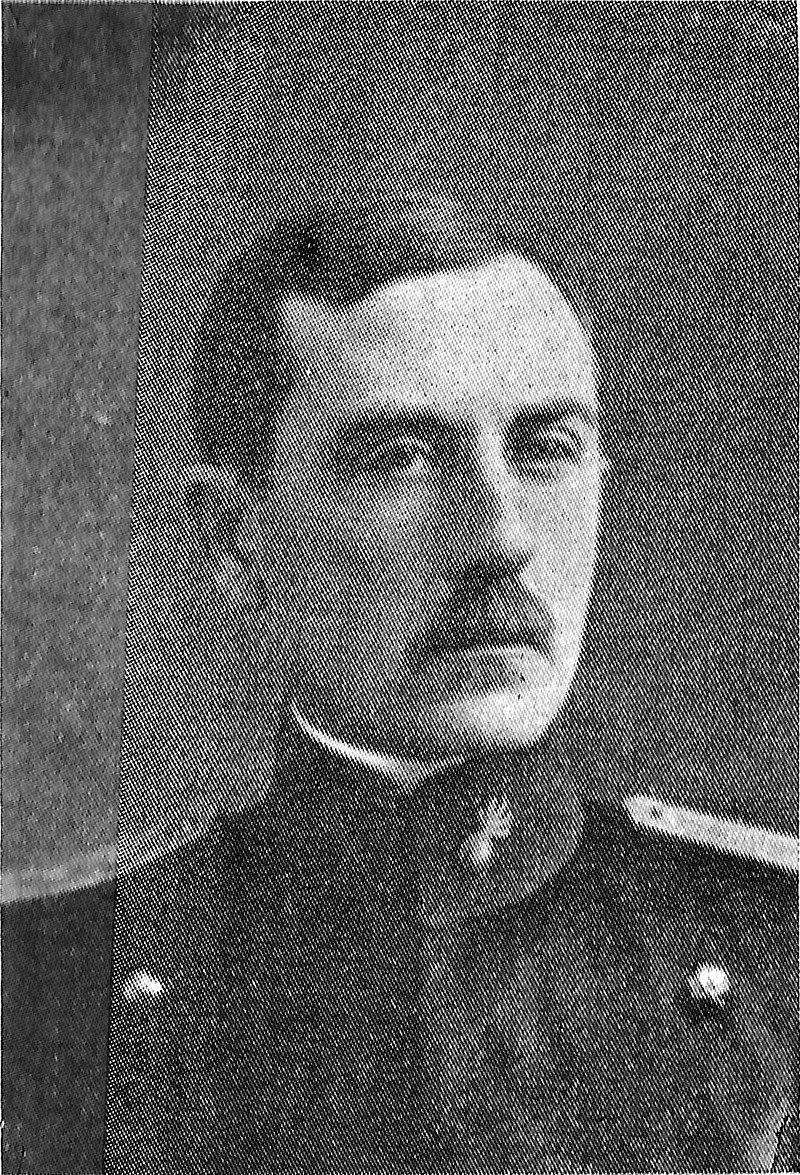
Rene de Saussure
The unit of currency used by the Cekbanko was the spesmilo. The spesmilo was developed as a universal currency by Rene de Saussure, a Swiss mathematician and linguist. One spesmilo was made up of 1,000 speso. Its value was pegged at 0.8 grams of 22 karat gold. It was the equivalent of approximately fifty US cents or two shillings. One and two spesmilo tokens were minted in 1912.
The symbol for the spesmilo.
Esperantists adopted the spesmilo for transactional use and Esperanto publications quoted prices in the currency. At its height, the Cekbanko had 730 accounts in 320 cities in 43 countries. WWI and Hoveler’s death in 1917 brought an end to the Cekbanko.
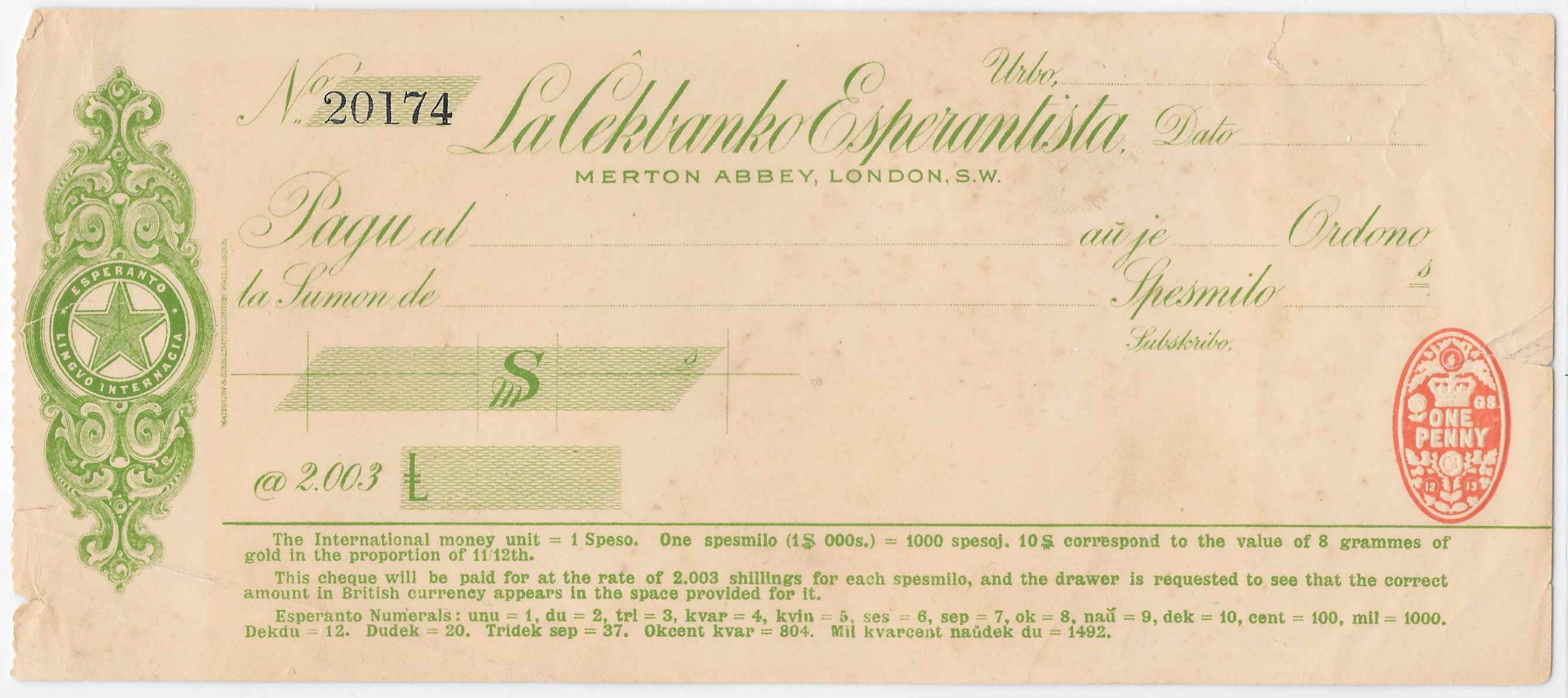
This check was printed for use by La Cekbanko Esperantista. It carries a one penny English revenue stamp dated April 12, 1913 which was required on all checks in use in England. The main text is entirely in Esperanto with English explanatory notes at the bottom. The amount of the check was to be written in both spesmilo and l/s/d in order to clear through the English banking system.
It was printed by Waterlow & Sons of London, a noted banknote printer.
If you want to see what a national emergency looks like, take a trip back eighty-six years to the beginning of 1933. The country was in the midst of the Great Depression and FDR was taking the helm.
One of his first acts as president was to declare an emergency in the financial system and order all the banks in the United States closed. The economic downturn had caused many banks to fail and there were runs on the deposits of the banks that remained. The entire system was on the verge of collapse.
Depositors lined up outside a closed bank in March 1933. National Archives.
Many state governors had ordered their banks closed prior to FDR’s order. The closing of banks in Michigan at the end of February 1933 led to a drain on the banks in northern Ohio as the Michigan banks withdrew deposits from their correspondent banks in Ohio. On February 28, 1933, George White, the Governor of Ohio, closed banks in the Buckeye State.
The closing of the banks did not put an end to commerce in the country. But it did put a halt to deposits and withdrawals at banks as well as check cashing and clearing. Government and business scrambled to find a way to keep the economy moving despite its weakness. Taxes, rents, wages and other debts had to be paid but there was limited cash available.
Many communities took to issuing scrip as a cash substitute to keep business moving. The scrip was local currency that was intended to circulate as long as necessary and would be redeemed at a later date.
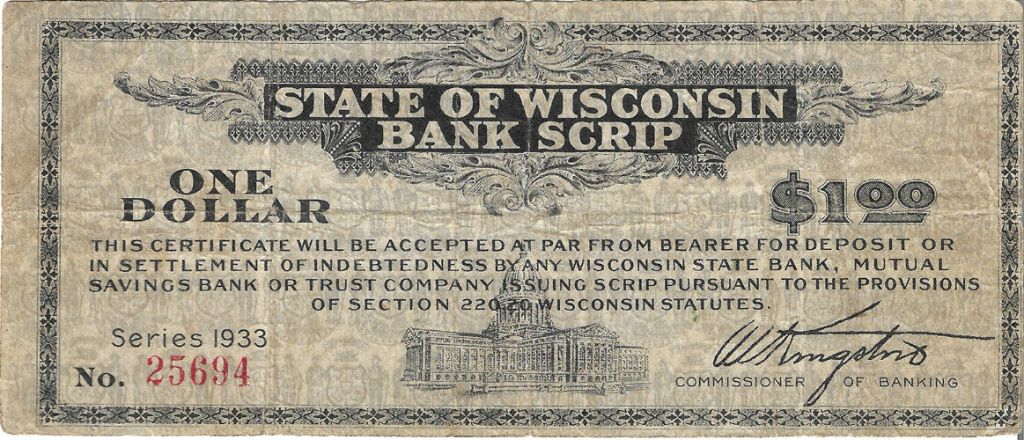
Wisconsin was the only state to have state-wide scrip issued during the 1933 Bank Holiday. Over $3,000,000.00 in scrip was issued to Wisconsin state chartered banks between March and June 1933.
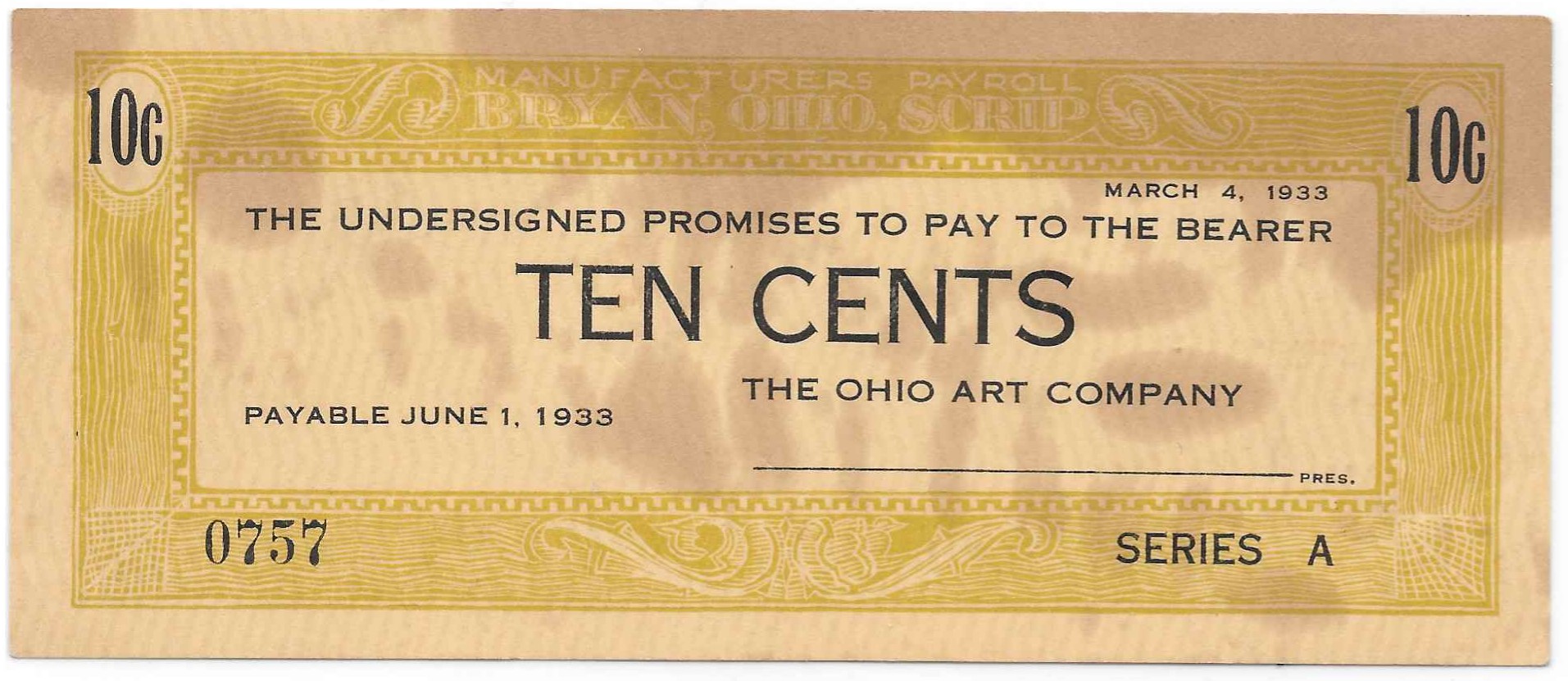
March 4, 1933 was a Friday and with many banks already closed, scrip was necessary to make the payroll. In Bryan, OH, the businesses that could not make their payroll had a uniform style scrip printed that carried the name of each issuing business.
One of those businesses that had difficulty making its payroll in Bryan, OH on March 4, 1933 was the Ohio Art Company. Then (and now) the company specialized in metal lithography. A generation later millions of children would know the Ohio Art Company as the producer of the Etch-a-Sketch.



















 Numismatic Notebook